History & Heritage
Under China’s subway lines and skyscraper foundations lies another country entirely — drowned capitals, desert ghost towns, and cities stacked on cities. Some of it you can actually visit.
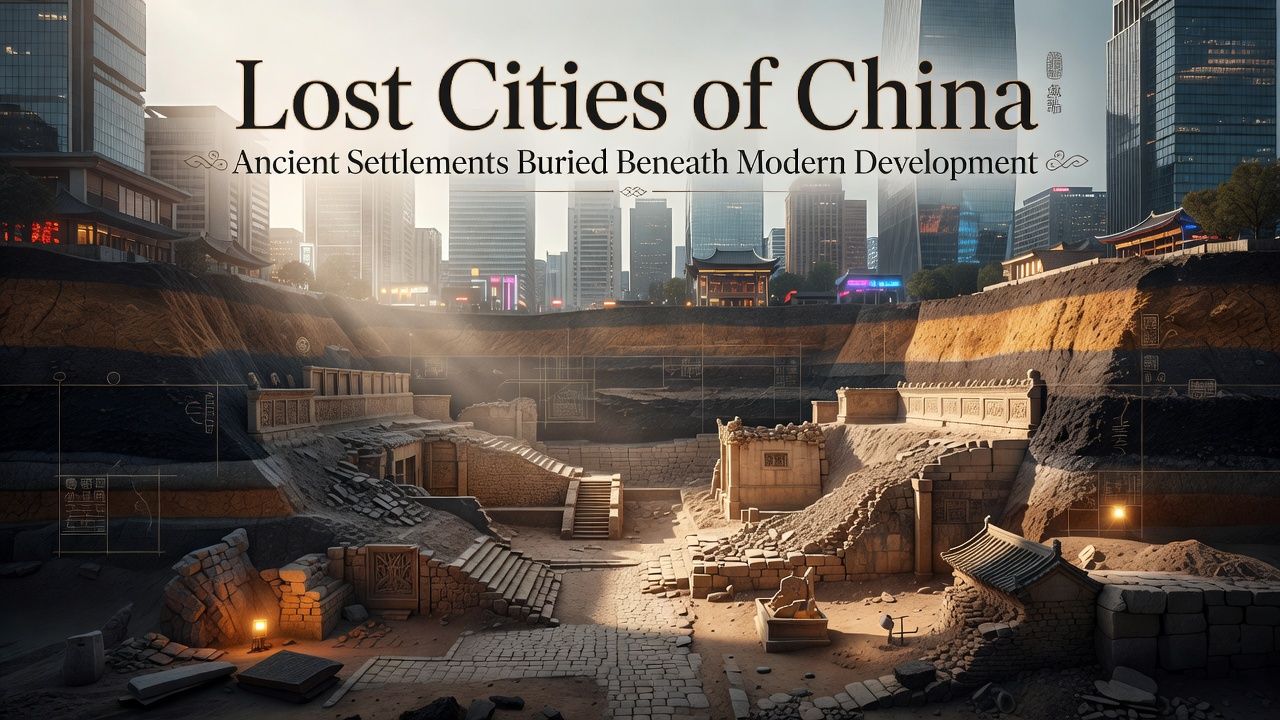
Every fast-growing country digs up its past by accident, but China does so on a scale no other civilization can match — because no other country combines five thousand years of dense urban history with the largest construction boom humanity has ever staged. When workers excavate a subway line in Xi’an, Luoyang, or Chengdu, they are tunneling through layer-cakes of former capitals; Chinese archaeology journals read like construction-site police blotters, with Han tombs under airport runways and Ming streets under shopping malls. Some discoveries stop the bulldozers and become museums; others are recorded and reburied beneath the towers. The result is a landscape where the lost cities aren’t only in remote deserts — they’re directly underfoot, and modern China is, quite literally, built on top of ancient China.
This article tours that hidden layer: the sensational accidental finds that rewrote history, the desert cities the Silk Road left to the sands, the drowned towns beneath reservoirs, and the “stacked capitals” where a dozen dynasties occupied the same ground. It’s also a practical guide, because a surprising number of these lost places are visitable — several with UNESCO recognition and world-class site museums, documented on the UNESCO World Heritage List. Few travel experiences match standing in an excavated pit where an entire unknown civilization surfaced fifty years ago, or walking a rammed-earth city the desert preserved for fifteen centuries. China’s lost cities are not a metaphor. They have street plans, and some still have opening hours.
Found by accident: the discoveries that rewrote the story
China’s most famous lost city moment came in March 1974, when farmers digging a well near Xi’an struck pottery fragments that turned out to be the Terracotta Army — thousands of life-size soldiers guarding the still-unexcavated tomb of the First Emperor. But an arguably stranger discovery had come decades earlier and matured more slowly: Sanxingdui, in Sichuan province. First hinted at by a peasant’s find in 1929 and blown open by excavations from 1986 onward, Sanxingdui revealed a sophisticated Bronze Age civilization — contemporary with the Shang dynasty but wildly different from it — that no historical text had ever mentioned. Its sacrificial pits yielded objects unlike anything else in Chinese archaeology: colossal bronze masks with protruding cylindrical eyes, a bronze “tree of life” several meters tall, gold scepters and masks. The finds were so alien that they forced historians to abandon the old model of Chinese civilization radiating from a single Yellow River cradle; clearly, multiple advanced cultures had flourished in parallel. Fresh pits excavated in the 2020s produced new sensations, and the gleaming Sanxingdui Museum near Chengdu is now among China’s most exciting archaeological destinations.
The pattern keeps repeating. At Liangzhu, near Hangzhou, excavations revealed a 5,000-year-old city with massive earthen walls and a hydraulic system of dams and canals so sophisticated it stunned engineers — evidence of an organized state a millennium before China’s traditionally “first” dynasty, now UNESCO-listed and open as a superb archaeological park. In Chengdu, builders found Jinsha, apparently Sanxingdui’s successor city, its golden “sun bird” disc now the emblem of Chinese cultural heritage. And beneath the old capitals, subway construction functions as permanent excavation: Luoyang’s metro dug through the stacked remains of multiple dynastic capitals, and Xi’an’s lines were routed around tomb clusters the way other cities route around utility pipes. In China, the question is rarely whether there’s an ancient city below — it’s which one, and from which century.
The desert’s perfect preservations
If modern development buries cities, the desert does the opposite: it abandons and embalms them. The Silk Road’s shifting fortunes — rivers changing course, routes moving, empires withdrawing — left a necklace of ghost cities across China’s arid northwest, preserved by the same dryness that killed them. The masterpiece is Jiaohe, outside Turpan: a complete city carved and built atop a leaf-shaped plateau between two rivers, inhabited for over a thousand years and abandoned around the Mongol era. Because Jiaohe was largely excavated downward into the earth rather than built up, its streets, dwellings, temples, and even a baby cemetery survive as a coherent urban plan you can walk for hours — one of the world’s largest, oldest, and best-preserved earthen cities. Its neighbor Gaochang, a former kingdom’s capital where the monk Xuanzang preached on his journey to India, sprawls in vast melancholy ruin nearby; both are UNESCO-listed as Silk Road sites.
Deeper in the sands lie the cities that became legends. Loulan, once a thriving kingdom on the vanished lake Lop Nur, was swallowed so completely that it survived only in old texts until explorers relocated it in 1900 — the same desert region that yielded the famous naturally mummified “Tarim mummies,” some four thousand years old, now displayed in Urumqi’s regional museum. Niya, Miran, and Khara-Khoto (a Tangut city just over today’s Inner Mongolian frontier) surrendered documents, frescoes, and textiles that filled museums worldwide — much of it carried off by early twentieth-century foreign expeditions, a sore chapter in archaeology’s history that institutions such as the British Museum now openly discuss. Most deep-desert sites are closed or expedition-only, but the accessible ones — Jiaohe and Gaochang above all — deliver the full lost-city experience: silence, ruin, and streetscapes where the last footsteps before yours might have been centuries ago.
| Lost city | How it was lost | Visiting today |
|---|---|---|
| Sanxingdui (Sichuan) | Civilization vanished from history; found 20th c. | World-class museum near Chengdu — unmissable |
| Liangzhu (Zhejiang) | 5,000-year-old city; rediscovered by archaeology | UNESCO archaeological park + museum near Hangzhou |
| Jiaohe & Gaochang (Xinjiang) | Silk Road shifted; desert preserved them | Open ruins near Turpan; UNESCO-listed |
| Loulan (Lop Nur) | Lake and river vanished; sands took the city | Closed to general tourism; artifacts in Urumqi museum |
| Shi Cheng “Lion City” (Zhejiang) | Deliberately flooded by reservoir, 1959 | Intact underwater; advanced divers only; lake area lovely to visit |
| Yin Xu / ancient capitals | Cities stacked beneath later cities | Site museums at Anyang, Luoyang, Xi’an |
Drowned worlds: the cities beneath the water
Not all of China’s lost cities were lost to time — some were lost on a schedule. In 1959, the building of a hydroelectric reservoir in Zhejiang province flooded a valley containing two ancient county towns, including Shi Cheng, the “Lion City,” founded some 1,400 years ago. Its population was relocated, the waters rose, and the city vanished — until divers rediscovered it decades later in a state of eerie perfection. Protected from wind, sun, and demolition by cool fresh water, Shi Cheng survives with its Ming-and-Qing-era gates, memorial arches, carved lintels, and even wooden beams intact: a genuine Atlantis, forty meters down in what is now the resort area of Qiandao (“Thousand Island”) Lake. Diving it is possible for suitably certified divers through specialist operators, while everyone else can enjoy the beautiful lake and the story — and ponder the strange irony that flooding preserved what development above water rarely spares.
The theme repeats at colossal scale along the Yangtze, where the Three Gorges Dam — the largest hydroelectric project on earth — raised waters over more than a thousand known archaeological and historic sites in the early 2000s, prompting China’s biggest-ever rescue archaeology campaign. Some monuments were physically moved: temples were dismantled and rebuilt above the waterline, and the remarkable Shibaozhai pagoda was ringed with a protective coffer dam and now stands on its own island. Whole ancient counties, however, lie beneath the reservoir, their residents resettled in new towns on the slopes above — a modern chapter in a very old Chinese pattern of rivers, water management, and cities in negotiation. Cruising the Gorges today, you travel over drowned streets while their replacement cities glitter on the banks: the lost and the new, stacked vertically, in the most literal way imaginable.
Stacked capitals: cities standing on their ancestors
The subtlest lost cities are the ones hiding in plain sight beneath living ones. China’s ancient capital region — the corridor of Xi’an, Luoyang, Kaifeng, and Anyang — has hosted dynastic capitals for over three thousand years, usually on or beside the same favored ground, so each city stands on a compressed stratigraphy of its predecessors. Luoyang, capital to more than a dozen dynasties, is essentially an archaeological layer cake with traffic on top; Kaifeng is the textbook case, where repeated Yellow River floods buried successive cities under meters of silt, leaving the Song dynasty’s glittering capital — once among the largest cities on earth — entombed largely intact several meters beneath the modern streets, a “city stack” archaeologists probe but can never fully excavate with a living city overhead. Xi’an’s situation is so extreme that tomb discoveries during construction are routine municipal events; the city’s subway map is partly a map of what archaeology allowed.
Modern China has learned to showcase this vertical history rather than merely pave it. Site museums now rise directly over excavations — at Anyang’s Yin Xu you walk above Shang chariot burials; Luoyang displays a Sui-Tang palace axis and preserved granaries; Xi’an’s Han Yangling museum leads you on glass walkways over an emperor’s miniature terracotta afterlife; and several cities have built “underground museums” into subway stations where construction finds are displayed exactly where they surfaced. This is also where China’s heritage-versus-development tension plays out daily: rescue archaeology races construction schedules, preservationists and planners negotiate over every major dig, and organizations like ICOMOS engage globally with exactly these urban-heritage dilemmas. The encouraging trend is real — laws require archaeological survey before major construction, and spectacular finds increasingly stop projects rather than the reverse — but the sheer pace of building guarantees the tension never fully resolves.
A traveler’s guide to the underworld
For travelers, the practical good news is that China’s lost cities cluster conveniently along routes you’d want to travel anyway. A “buried China” itinerary might run: Hangzhou for Liangzhu’s 5,000-year-old dams and jades (an easy day trip, pairable with Qiandao Lake and the Lion City’s story); Chengdu for Sanxingdui and Jinsha, alongside the pandas and teahouses; Xi’an for the Terracotta Army, Han Yangling’s glass walkways, and a city that is its own museum; Luoyang and Anyang for the stacked-capital experience and the oracle bones where Chinese writing began; and, for the ambitious, the Turpan oases for Jiaohe and Gaochang — the desert’s perfect ghost cities — folded into a Silk Road journey. Every stop offers modern museums with strong English interpretation, and the household names (the Terracotta Army aside) draw far thinner crowds than the Great Wall circuit.
| Base city | Lost-city experiences within reach | Time needed |
|---|---|---|
| Hangzhou | Liangzhu park & museum; Qiandao Lake (Lion City) | 1–2 days |
| Chengdu | Sanxingdui museum; Jinsha site museum | 1–2 days |
| Xi’an | Terracotta Army; Han Yangling; city museums | 2–3 days |
| Luoyang / Anyang | Stacked-capital sites; Yin Xu oracle-bone site; Longmen caves nearby | 2 days |
| Turpan | Jiaohe & Gaochang ruins; karez channels; Urumqi museum’s mummies | 2 days (within a Silk Road trip) |
Go with the right expectations and habits: early-morning visits beat tour-bus waves; site museums reward slow reading, so budget real hours; respect barriers and no-photography rules, which exist because pigments and lacquers genuinely die in light; and read a little beforehand — UNESCO’s plain-language site descriptions are ideal — because context is everything at places whose drama is conceptual as much as visual. Above all, hold onto the central astonishment these places offer: that a civilization this old and this continuously built-upon still surrenders whole unknown cities — bronze-masked Sanxingdui in living memory, new pits in the 2020s, tomorrow’s find waiting under some subway extension. China’s past isn’t finished being discovered; it’s actively surfacing, one construction site at a time, and for once in travel the cliché is literally true — there really is another world beneath your feet.