History & Heritage
With one of the largest collections of World Heritage sites on earth — imperial palaces, sacred mountains, rice terraces, panda sanctuaries — China is a UNESCO treasure map. Here’s how to navigate it.
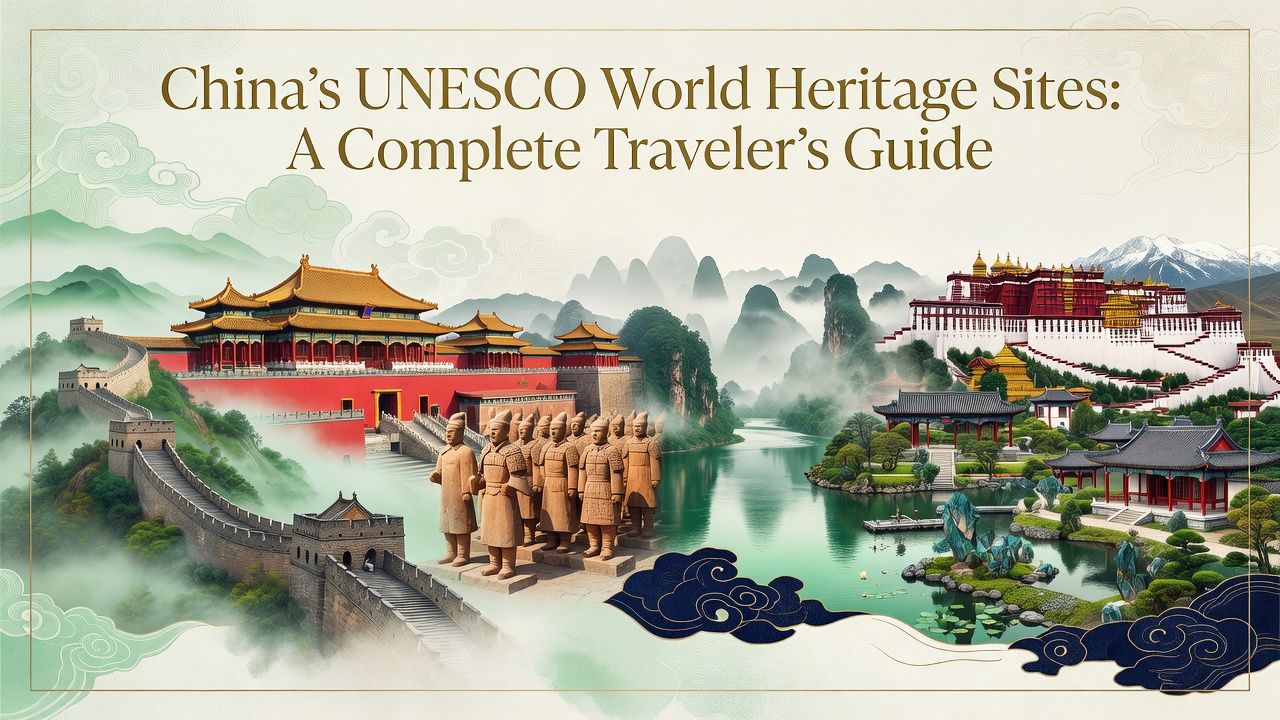
When UNESCO began inscribing World Heritage sites in the late 1970s, China wasn’t even a participant — it joined the convention only in 1985. Within two years it had six sites inscribed at once, including the Great Wall, the Forbidden City, and the Terracotta Army’s mausoleum, and it has been adding them nearly every year since. Today China holds one of the world’s two largest national collections — trading the top spot with Italy depending on the year’s inscriptions, with the count near sixty — spanning an almost absurd range: imperial palaces and garden cities, Buddhist cave galleries, sacred mountains climbed by pilgrims for two millennia, karst stone forests, Tibetan palaces, tulou earthen fortresses, panda habitat, and a fossil site that rewrote the story of early life. No other country’s list covers so many categories of human and natural achievement at once.
For travelers, the UNESCO list is the single most useful trip-planning document China offers — a pre-vetted register of the country’s most significant places, each with a plain-language justification published on the UNESCO World Heritage Centre site that makes superb pre-trip reading. But a list of dozens of sites scattered across a continent-sized country needs a strategy, and that’s what this guide provides: how the list is organized, the essential sites by category, honest notes on crowds and effort, and realistic itineraries that string the highlights together. Treat it as a menu rather than a checklist — nobody should attempt all of them in one trip, and the joy is in choosing your China: imperial, sacred, vernacular, or wild.
Understanding the list: culture, nature, and both
UNESCO inscribes three kinds of sites, and China excels at all of them. Cultural sites form the majority — the palaces, tombs, temples, grottoes, classical gardens, and historic towns that document five thousand years of civilization. Natural sites protect landscapes and ecosystems of global significance — from the sandstone pillar forests of Zhangjiajie’s region to the turquoise lakes of Jiuzhaigou and the panda sanctuaries of Sichuan. Rarest and most distinctive are the mixed sites, honored for both at once — and China’s four (Mount Tai, Mount Huang, Mount Emei with the Leshan Giant Buddha, and Mount Wuyi) reveal something essential about Chinese civilization: its sacred mountains are simultaneously natural wonders and cultural monuments, carved with centuries of temples, poems, and pilgrim stairways, because Chinese tradition never fully separated nature from culture in the first place.
A few practical realities of the list are worth knowing before planning. Several inscriptions are “serial” sites — one listing covering many locations, sometimes across provinces: the Great Wall inscription spans thousands of kilometers and multiple visitable sections; “Ancient Villages in Southern Anhui” means the pair of Xidi and Hongcun; the Silk Road inscription alone bundles dozens of sites shared with neighboring countries. Site quality of experience also varies enormously with fame: the marquee names (Great Wall, Forbidden City, Terracotta Army) draw crowds on a scale that demands tactics, while equally magnificent inscriptions — the Chengde mountain resort, the Dazu rock carvings, Fujian’s tulou — can feel almost private midweek. And infrastructure is generally superb: China has invested heavily in visitor centers, transport links, and (a mixed blessing) cable cars at its heritage sites, so access is rarely the obstacle — choosing well is.
The essential sites, by category
You cannot see them all, so here is the honest shortlist — the sites that best represent each face of China’s heritage, chosen for significance and traveler experience together:
| Category | Essential sites | Why they lead the list |
|---|---|---|
| Imperial power | Great Wall; Forbidden City; Temple of Heaven; Summer Palace; Ming & Qing tombs; Terracotta Army (Qin mausoleum); Chengde | The machinery of the world’s longest-running empire — most cluster conveniently around Beijing and Xi’an |
| Buddhist art | Mogao Caves (Dunhuang); Longmen Grottoes; Yungang Grottoes; Dazu Rock Carvings; Leshan Giant Buddha | A millennium of cave-temple art; Mogao is the world’s greatest painted gallery, Leshan a 71-meter cliff-carved Buddha |
| Sacred mountains | Mount Tai; Mount Huang (Huangshan); Mount Emei; Mount Wuyi; Mount Wutai | Where landscape and worship merge — Huangshan’s granite-and-pine scenery is the source code of Chinese landscape painting |
| Gardens & towns | Classical Gardens of Suzhou; Old Town of Lijiang; Ancient City of Ping’yao; West Lake (Hangzhou); Xidi & Hongcun villages; Fujian tulou; Kulangsu (Gulangyu) | Living heritage: scholar gardens, intact walled Ming banking town, Naxi canal town, communal earthen fortresses |
| Natural wonders | Jiuzhaigou; Huanglong; Wulingyuan (Zhangjiajie); South China Karst; Sichuan panda sanctuaries; Danxia landforms | Turquoise alpine lakes, quartzite pillar forests, stone forests, rainbow mountains — scenery with no global equal |
| Frontier & roads | Potala Palace ensemble (Lhasa); Silk Road corridor sites; Grand Canal; Honghe Hani Rice Terraces | The empire’s edges and arteries — and Yunnan’s sculpted terrace landscapes, among Asia’s most beautiful human creations |
Special mention belongs to a few less-famous inscriptions that reward the curious: Ping’yao, a completely walled Ming-Qing banking town where you can sleep in courtyard inns inside the walls; the Dazu carvings near Chongqing, where Song dynasty sculptors filled cliff amphitheaters with vividly human Buddhist tableaux and far fewer visitors than the northern grottoes; the Fujian tulou, colossal circular rammed-earth apartment-fortresses still inhabited by the Hakka families who built them; and the Chengjiang fossil site in Yunnan, whose Cambrian fauna helped document the explosion of complex life — proof of how deep the list’s range runs.
Building an itinerary: heritage routes that actually work
Geography is kind to heritage travelers in China: the sites cluster into natural circuits connected by the world’s largest high-speed rail network, so a well-designed trip strings multiple inscriptions with minimal backtracking. The classic first-timer’s spine — Beijing, Xi’an, and the Shanghai-Hangzhou-Suzhou triangle — alone touches nearly a dozen inscriptions, from the Wall and the palaces to the Terracotta Army, West Lake, and the Suzhou gardens, with the Grand Canal threading through the finale. Add one deliberate detour matched to your taste — Huangshan for scenery, Dunhuang for art, Pingyao for time travel — and you have a two-week trip of extraordinary density.
| Route | Heritage sites covered | Time |
|---|---|---|
| Imperial classic Beijing → Pingyao → Xi’an |
Great Wall, Forbidden City, Temple of Heaven, Summer Palace, Ming tombs; Pingyao; Terracotta Army | 8–10 days |
| Gardens & water towns Shanghai → Suzhou → Hangzhou (+ Huangshan) |
Suzhou gardens, Grand Canal, West Lake; add Huangshan + Xidi/Hongcun villages | 6–9 days |
| Buddhist art road Datong → Wutai → Luoyang → Xi’an → Dunhuang |
Yungang, Mount Wutai, Longmen, Silk Road sites, Mogao Caves | 10–14 days |
| Wild southwest Chengdu → Jiuzhaigou/Huanglong → Leshan/Emei → Yunnan |
Panda sanctuaries, alpine lakes, Giant Buddha & sacred mountain, Lijiang, Hani terraces | 12–16 days |
| One-week sampler Beijing + Xi’an only |
Six-plus inscriptions between two cities, linked by direct high-speed rail | 6–7 days |
Crowds, timing, and the art of the heritage visit
The defining variable of Chinese heritage travel isn’t cost or access — it’s crowd management, and a little knowledge transforms everything. The iron rules: never visit marquee sites during China’s national holidays (the early-October Golden Week and Lunar New Year period above all, plus early-May), when domestic tourism reaches oceanic scale; favor shoulder seasons (April–May, September–October for weather; November and March trade some comfort for wonderful emptiness); arrive at opening time, when even the Forbidden City grants you an hour of relative calm; and remember the fifty-meter rule — at almost every famous site, crowds cling to the central path and the cable-car route, so walking sections instead of riding, or detouring to secondary areas, buys astonishing solitude. At the Great Wall specifically, choosing restored-but-quieter sections like Mutianyu or Jinshanling over Badaling is the single best decision a first-timer makes.
Booking mechanics matter too: major sites now require advance online reservation with passport details, daily visitor caps genuinely sell out in season, and popular caves (Mogao’s timed tickets especially) should be secured well ahead. Budget realistic time — heritage sites in China are often vast, and the “half-day” estimate on a tour brochure shortchanges places like the Forbidden City or Huangshan badly. And approach the experience with calibrated expectations about restoration: Chinese heritage practice, rooted in a tradition of cyclical renewal (temples were always repainted; the Ise-style logic of maintenance-as-preservation runs deep in East Asia), leans more heavily on reconstruction than Western conservation purists prefer, so some sites gleam rather than crumble. The debate is legitimate — bodies like ICOMOS engage with it constantly — but the traveler’s wisest stance is to understand the philosophy rather than merely judge it, and to seek out the genuinely ancient (the cave paintings, the unrestored “wild wall,” Pingyao’s untouched lanes) alongside the renewed.
Beyond the monuments: intangible heritage
UNESCO’s recognition of China extends beyond places to practices: the parallel Intangible Cultural Heritage lists, browsable at ich.unesco.org, inscribe dozens of Chinese traditions — Peking opera, calligraphy, the guqin zither, tea processing, acupuncture, shadow puppetry, the dragon-boat festival, Kunqu opera — and they point to the richest layer of heritage travel: the living one. The listed monuments become exponentially more meaningful when paired with their living context — watching calligraphers practice with water brushes in a Beijing park before visiting the palace they once served; taking a tea-ceremony class in Hangzhou between garden visits; catching an opera performance in a historic Suzhou garden theater. China’s heritage was never only architecture; it is a continuing performance, and the intangible list is your program guide.
The deepest reward of traveling China by its World Heritage list, in the end, is the education it smuggles in. Site by site, the list assembles the full portrait: the imperial machine (Beijing), the first unification (Xi’an), the Buddhist transformation (the grottoes), the scholar’s ideal (Suzhou), the merchant’s world (Pingyao, the Canal), the frontier (Lhasa, the Silk Road), and the land itself that shaped it all (the sacred mountains, the karst, the terraces). Few countries can narrate themselves so completely through their protected places, and none makes the narration so logistically easy to follow. Pick your route from the table, book the timed tickets, dodge Golden Week, arrive at opening — and let one of humanity’s greatest heritage collections tell you, in stone, water, and mountain, the longest continuous story any civilization has to offer.