Food & Culinary Culture
Steamer baskets, rolling carts, tea etiquette, and a menu of little masterpieces — dim sum is one of the world’s great eating rituals. Here’s the complete beginner’s briefing.
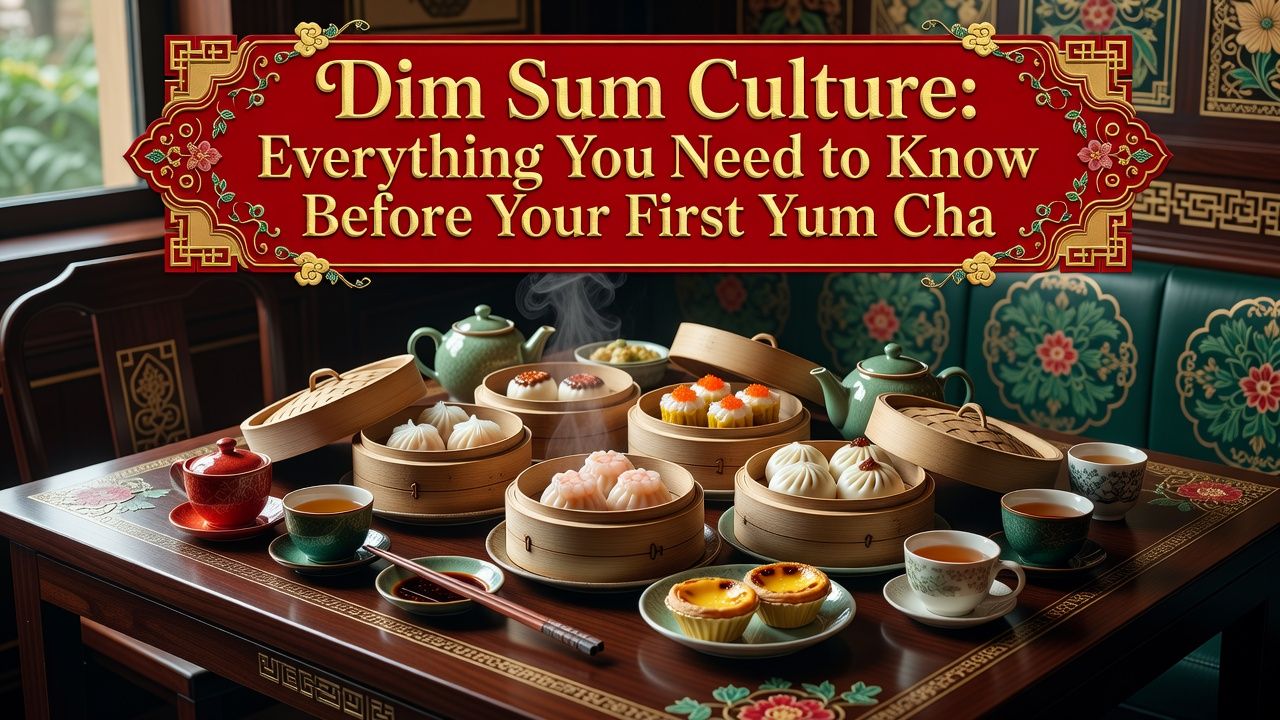
The words themselves set the tone: dim sum means, roughly, “touch the heart” — small foods meant to delight rather than merely fill — while yum cha, “drink tea,” names the occasion around them. Strictly speaking, you don’t go out for dim sum; you go to yum cha, the leisurely Cantonese ritual of tea-drinking accompanied by an endless parade of small dishes, and the distinction captures something essential. This is not fast food in small portions; it’s a social institution — the weekend gathering where three generations argue over newspapers and the last har gow, where business is discussed and matches are made, where retirees settle in at 9 a.m. and hold their tables like territory. To understand dim sum is to understand a whole way of spending a morning.
The tradition’s roots reach back over a millennium to the teahouses of the Silk Road and southern trade routes, where travelers rested and snacks gradually joined the tea — overturning an old medical belief that eating with tea was unwise. It was in Guangzhou and later Hong Kong that the form flowered into its modern glory: specialized teahouses, a canon of hundreds of dishes, dedicated dim sum chefs whose dumpling-pleating skills take years to master, and eventually the beloved theater of steam-cart service. Cantonese emigration then carried it worldwide, making dim sum one of Chinese cuisine’s great global ambassadors — a status reflected in the broader recognition of Chinese tea culture on UNESCO’s intangible heritage lists at ich.unesco.org. For the first-timer, though, the experience can be gloriously chaotic: carts flying past, unfamiliar dishes, tea rituals everyone else seems born knowing. This briefing fixes that.
How yum cha works: carts, checklists, and the rhythm of the room
Walk into a classic dim sum hall — ideally a big, bright, roaring one on a weekend morning — and the mechanics reveal themselves quickly. In traditional cart service, servers push trolleys of bamboo steamers and covered dishes through the aisles, calling their contents; you flag down what tempts you, point, and the server stamps your table’s card, which tallies the bill by dish size (small, medium, large, special). It’s dining as a moving buffet, and half the fun: you see everything before choosing, discoveries roll past unbidden, and strategy matters — sit along a cart route rather than a far corner, and intercept the kitchen-fresh carts early in their circuit. Many modern restaurants have replaced carts with paper checklists or tablets, trading theater for freshness (made-to-order arrives hotter); purists debate it endlessly, but the food logic favors ordering sheets, and the great halls of Hong Kong and Guangzhou now run both systems side by side.
Timing and pace are part of the culture. Dim sum is traditionally a morning-through-lunch affair — roughly breakfast to mid-afternoon, with weekend prime time around late morning drawing queues that are themselves part of the ritual; arriving at opening beats the rush and catches the kitchen at its freshest. Once seated, resist the beginner’s urge to order everything at once: yum cha is a marathon of small waves, not a single feast — a few steamers, tea, conversation, then a few more. Dishes arrive as they’re ready and are shared from the center, everyone plucking with chopsticks from the communal baskets (serving chopsticks, when provided, are for moving food to your plate). Tables turn slowly and nobody hurries you; lingering is the point, which is exactly why the retirees you’ll see treating the teahouse as a second living room are not lingering — they’re doing it correctly.
The tea half of yum cha: rituals worth knowing
Since the occasion is named for tea, the tea etiquette matters — and mastering three small rituals will mark you as someone who knows. First, the tea choice opens the meal: the server’s first question is what tea the table drinks, and the classic answers are pu-erh (dark, earthy, considered ideal against rich food — the default of serious yum cha), jasmine (fragrant and friendly), tieguanyin oolong (floral-toasty), or chrysanthemum (caffeine-free and gentle). Second, the refill signal: when your teapot runs empty, don’t chase a server — simply tilt the pot’s lid ajar or rest it on the handle, the universal sign that quietly summons hot water. Third, and loveliest, the finger tap: when someone pours tea into your cup, tap two fingers lightly on the table in thanks — a gesture folklore traces to an incognito emperor whose companions, unable to bow without exposing him, “kowtowed” with their fingers instead. Always pour for others before yourself; elders first.
A few more courtesies complete the toolkit. Some traditional halls bring a bowl of hot water for rinsing your cup, bowl, and chopsticks at the table — a customary ritual more about ceremony than sanitation; follow your neighbors’ lead. Chopstick basics apply as everywhere in China: never stand them upright in rice (funerary symbolism), don’t spear food, and rest them on the holder or bowl edge. Sauces — soy, chili oil, hot mustard — are accents, not baths; the Cantonese kitchen seasons its dumplings to be complete, and drowning a chef’s har gow in soy is gently frowned upon (chili oil on the other hand has enthusiastic license with siu mai). None of this etiquette is policed — dim sum rooms are warm, loud, and forgiving — but the small gestures earn smiles, and the finger-tap alone is worth the price of this article.
The essential menu: your first-timer’s ordering guide
The dim sum canon runs to hundreds of dishes, but a core repertoire appears everywhere, and knowing a dozen names unlocks the whole experience. Here is the field guide — the classics, what they are, and how the connoisseurs judge them:
| Dish | What it is | Mark of quality |
|---|---|---|
| Har gow 虾饺 | Shrimp dumplings in translucent crystal skins | The benchmark dish: thin see-through wrapper, 7–10 pleats, snappy whole shrimp |
| Siu mai 烧卖 | Open-topped pork & shrimp dumplings | Juicy, springy bite; often crowned with roe |
| Char siu bao 叉烧包 | Fluffy steamed buns with sweet BBQ pork | Snow-white bun split open at the top; also seek the baked version |
| Cheung fun 肠粉 | Silky rice-noodle rolls (shrimp, beef, or crisp dough) in sweet soy | Sheets so tender they barely hold together |
| Cha siu / lo mai gai 糯米鸡 | Sticky rice with chicken & treasures, steamed in lotus leaf | Perfumed by the leaf; a meal in a parcel |
| Cha siu sou / spring rolls | The fried & flaky contingent | Shattering crispness, never greasy |
| Fung zao 凤爪 | “Phoenix claws” — braised chicken feet in black-bean sauce | The adventurous badge of honor; all gelatin-rich skin and sauce |
| Lo bak go 萝卜糕 | Pan-fried turnip (daikon) cake | Crisp golden crust, soft savory interior |
| Dan tat 蛋挞 | Egg tarts — the classic sweet finish | Wobbling custard in flaky (or cookie-crust) pastry, served warm |
| Lai wong bao 流沙包 | Molten salted-egg custard buns | The modern cult favorite — the center should flow |
A sensible first-timer’s order for two people: har gow, siu mai, char siu bao, one cheung fun, one fried item, a plate of stir-fried greens (gai lan with oyster sauce — always available, always welcome), and egg tarts to finish — six or seven baskets, adding more if appetite allows. Vegetarians fare better than the pork-forward canon suggests: mushroom or vegetable dumplings, sticky rice variants, turnip cake (check for dried shrimp), greens, and the sweets cover a satisfying spread, and larger halls increasingly mark vegetarian items. And everyone should order at least one dish they can’t identify — it’s the yum cha way.
Where to go: from Guangzhou halls to your local weekend spot
The tradition’s twin capitals remain Guangzhou — where “morning tea” is practically a civic institution and grand old teahouses serve dawn-to-afternoon — and Hong Kong, whose dim sum spectrum runs from rowdy cart palaces and cook-to-order neighborhood joints to the famous budget spot that earned a Michelin star for barbecue-pork buns, and onward to refined hotel dining rooms reinventing the canon. Both cities repay the classic strategy: one grand, roaring, weekend-morning hall for the full cultural spectacle, and one small specialist for the best pure cooking. Across the Cantonese diaspora, the tradition thrives wherever the community settled — the great Chinatowns and suburban Cantonese enclaves of Vancouver, Toronto, San Francisco, Los Angeles, New York, Sydney, and London all sustain serious yum cha cultures, and the same signals identify the good rooms everywhere: Cantonese-speaking crowds, multigenerational tables, weekend queues, and har gow with skins you can read through.
However far it travels, dim sum’s heart stays the same, and it’s worth naming as you plan your first visit: this is food engineered for togetherness. The small portions exist so a table can taste everything; the tea rituals exist to make people serve one another; the unhurried pace exists because the meal’s real product is the conversation around it. Go with a group if you can — more people means more baskets means more discoveries — claim a table mid-morning, choose your tea, tap your fingers in thanks, and let the steamers accumulate into a leisurely two-hour argument about which dumpling wins. Somewhere between the first har gow and the last egg tart, you’ll understand why a billion people consider this the correct way to spend a Sunday — and why the little foods were named, a thousand years ago, for their ability to touch the heart.