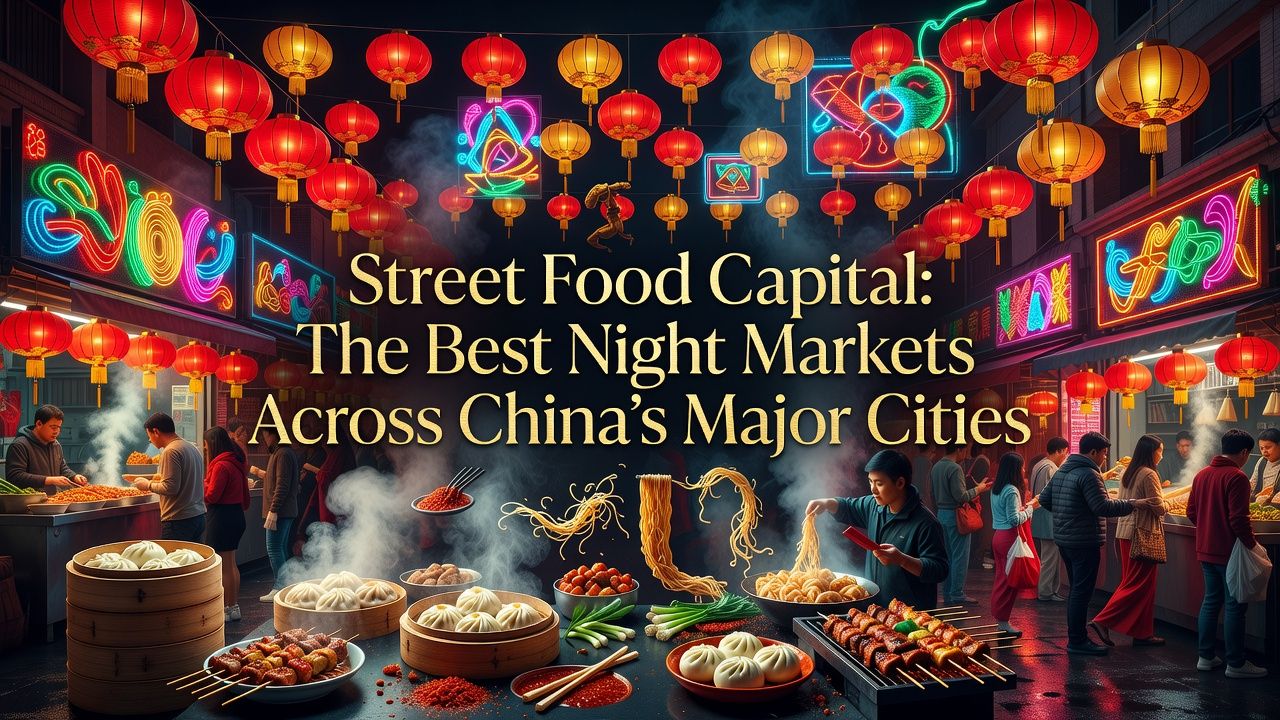
When the sun sets, China’s real dining rooms open: smoke, neon, sizzling griddles, and a thousand snacks for pocket change. Here’s the city-by-city guide to eating the night.
There is a specific hour in a Chinese city — somewhere around dusk, when the office towers empty and the first skewers hit the grills — when the entire relationship between the street and the stomach changes. Folding tables sprout on sidewalks, steam and charcoal smoke braid together under strings of lights, vendors’ calls compete with the hiss of woks, and whole boulevards convert into open-air dining rooms that will roar until well past midnight. This is xiaochi culture — “small eats” — and it is arguably China’s most democratic culinary institution: everyone from students to executives perched on the same plastic stools, eating the same grilled lamb and stinky tofu for a handful of yuan. The night market isn’t a tourist attraction that locals tolerate; it’s where locals actually eat, and that is precisely what makes it the best possible introduction to how a city truly tastes.
Night-market eating rewards a little strategy, because China’s street-food scene is enormous, regionally distinct, and in flux — many cities have moved their most chaotic street stalls into organized food streets and covered snack markets over the past decade, which trades some grit for convenience, while true street-level scenes still flourish in others, and the famous “tourist food streets” of several cities are, frankly, better for photos than for dinner. This guide covers both the where and the how: the essential markets and food streets city by city, the iconic snacks to hunt in each, how to tell a great stall from a tourist trap, and the practical matters — payment, hygiene, etiquette — that make the difference between dabbling and feasting. General food-safety sense for travelers is covered well by the CDC’s travel health pages; everything else, the markets themselves will teach you.
The night-market map: where each city shines
Every major Chinese city has a signature night-eating scene, and they differ as much as the regional cuisines behind them. Here is the essential circuit — with honest notes on which famous names deserve their fame:
| City | Where to eat the night | Hunt these |
|---|---|---|
| Xi’an | The Muslim Quarter (Huimin Jie) and its side lanes — China’s most atmospheric food district, a thousand years deep; go beyond the main drag into the alleys | Roujiamo “burgers,” yangrou paomo lamb-bread soup, biang biang noodles, persimmon cakes, pomegranate juice |
| Chengdu | Jianshe Road’s snack street; old-town lanes; teahouse districts — a UNESCO City of Gastronomy that snacks around the clock | Chuan chuan skewers from the pot, dan dan noodles, rabbit head (for the brave), bing fen sweet jelly, spicy dumplings |
| Chongqing | Riverside and old-lane districts; hotpot alleys glowing under the megacity’s neon canyons | Street hotpot & mala everything, xiaomian breakfast-noodles-at-midnight, grilled fish |
| Beijing | Hutong food streets and neighborhood snack clusters (the famous old tourist snack street era has passed — eat where the hutongs live instead) | Jianbing crepes, lamb skewers, zhajiangmian noodles, candied hawthorn (tanghulu), baozi |
| Shanghai | Morning-to-night snack streets and old-town lanes; scallion-pancake and dumpling hole-in-the-walls across the former French Concession fringes | Shengjianbao pan-fried soup buns, scallion pancakes, xiaolongbao, stinky tofu |
| Guangzhou | Shangxiajiu & Beijing Road areas; late-night dai pai dong-style eateries — the south’s siu yeh (night supper) culture at full power | Claypot rice, beef brisket noodles, fresh seafood, chee cheong fun, dessert soups |
| Kaifeng | The Gulou (Drum Tower) night market — the classic old-school northern night market experience, tables filling the square after dark | Five-spice bread, soup dumplings, almond tea, grilled everything |
| Ürümqi & the northwest | Grand bazaar-adjacent food courts and Uyghur night markets across Xinjiang’s cities | Cumin lamb skewers, tandoor naan, laghman, samsa pastries, fresh melon |
Two honest asterisks belong on any such list. First, the most heavily marketed “snack streets” in several big cities — the ones on every postcard — have drifted toward tourist pricing and photogenic novelty food; they’re worth a stroll, but the eating is almost always better one or two streets away where the queue is local. Second, the scene evolves: city management periodically relocates stalls into regulated night markets and food courts, so the exact address matters less than the skill of finding the current gravitational center — which any hotel receptionist, taxi driver, or twenty-something local will name instantly if asked “where do you eat at night?” That question, asked sincerely, outperforms every guidebook ever printed.
The greatest hits: a snack literacy course
Certain snacks form the shared vocabulary of Chinese night eating, appearing in regional accents everywhere, and knowing them lets you read any market at a glance. The skewer (chuan’r) is the universal grammar — lamb with cumin and chili is the classic, but markets skewer everything from chicken wings to whole squid to enoki-wrapped beef, grilled over charcoal while you point at what you want. Jianbing, the made-to-order breakfast crepe with egg, crisp cracker, scallions, and sauces, has become an all-hours icon. The stinky-tofu stall announces itself from fifty meters — fermented tofu deep-fried and sauced, smelling far worse than it tastes, and the single best test of a traveler’s spirit of adventure (the flavor is mild, savory, and genuinely good; the smell is the toll). Noodles anchor every region’s night — hand-pulled in the northwest, dan dan in Sichuan, hot-dry in Wuhan — and the sweet finale is universal too: tanghulu’s candied fruit lacquered in hard sugar, sesame balls, grilled milk custards in the south, fresh-cut fruit and juices everywhere.
Then there are the regional one-offs worth traveling for: Xi’an’s roujiamo — slow-braised spiced pork stuffed into a griddled flatbread, plausibly the world’s oldest “burger”; Shanghai’s shengjianbao, soup dumplings pan-fried to a crisp bottom, requiring the technique every local knows (nibble a hole, sip the scalding broth, then bite — ignoring this is how tourists get soup on their shirts); Changsha’s black stinky tofu and crayfish mountains; Chengdu’s chuan chuan, skewers you pull by the fistful from communal spice-broth pots and pay by counting the empty sticks. Every one of these comes with its own tiny etiquette and ideal condiment, and the vendors — endlessly patient with curious foreigners — are the best teachers: watch how the person before you eats it, do that, and you’ll rarely go wrong.
Choosing stalls like a local: the quality signals
Every experienced night-market eater runs the same subconscious checklist, and it’s easily learned. The supreme signal is the queue of locals — not tourists photographing, but residents waiting, ideally including delivery drivers and grandmothers, the two most discerning demographics in China. Turnover matters more than appearances: a busy stall’s food never sits, which is both a flavor and a safety advantage, while the deserted stall with the biggest sign is doubly suspect. Specialization is the third tell — the vendor who has made exactly one thing for twenty years beats the stall selling forty items, and many of China’s most storied street vendors are single-dish masters with lines around the block. Watch the cooking: made-fresh-before-you (the jianbing spread on the griddle, skewers hitting live charcoal) is the gold standard, and an organized, clean workstation usually reflects an organized cook.
| Green flags | Caution flags |
|---|---|
| Long local queue; delivery drivers waiting | Staff recruiting passersby; menus only in English |
| One specialty, cooked to order in front of you | Huge menu; food pre-cooked and sitting under lights |
| High turnover — ingredients visibly fresh & moving | Empty stall at peak hour in a busy market |
| Piping-hot, fully cooked items; clean prep area | Lukewarm food; raw items sitting out; (for sensitive stomachs) ice & raw garnishes early in your trip |
| Prices posted; locals paying the same as you | No prices anywhere; “special tourist” quotes |
On the health question, perspective helps: China’s busy night markets are, by dint of turnover and high-heat cooking, generally friendlier to the stomach than their smoky aesthetics suggest, and millions eat from them nightly without incident. Sensible travelers simply stack the odds — favor the fully cooked and freshly hot, ease into the rawer and colder items after a few days of acclimatization, carry hand sanitizer (napkins are scarce, and skewers are handheld), stay hydrated with sealed or boiled drinks, and follow the standard travel-food guidance the CDC publishes. The spicier risk is chili itself: Sichuan and Hunan market food takes no prisoners, and the phrase bu yao la (“no chili”) or wei la (“mildly spicy”) is worth memorizing before, not after, the first chuan chuan.
The practical night: money, ordering, and market manners
Modern Chinese street food runs on phones, and arriving prepared transforms the evening. Payment is overwhelmingly via the two big mobile-payment apps, which now accept foreign cards after registration — set this up before your trip, because many stalls handle little cash (though keeping small bills as backup is wise, and vendors will accommodate). Ordering needs almost no language: pointing is universal currency, quantities can be shown on fingers, menus are increasingly photographed, and translation apps bridge everything else — vendors deal with the whole world nightly and meet effort with warmth. A few manners smooth the way: join the queue’s end honestly (queue discipline at famous stalls is real), have payment ready at busy windows, dispose of skewers and bowls at the stall or bins rather than the street, and ask before photographing a vendor close-up — nearly all will beam and pose, but the asking is the courtesy.
Then commit to the correct strategy, which is the grazer’s crawl: never fill up at the first stall, however magnificent — order one item, share it, move on, and let the night accumulate into a ten-course progressive dinner across a dozen masters, finishing with fruit or something sweet. Go hungry, go with company if you can (more stomachs, more coverage), start around 7–8 p.m. when everything is open and freshest, and budget almost nothing — a spectacular market feast rarely costs more than a mediocre sit-down meal. Above all, understand what you’re really visiting: night markets are where Chinese cities relax — where the day’s formality drops, strangers share tables, and the country’s staggering culinary depth presents itself one small, perfect, three-yuan bite at a time. The great restaurants will show you what Chinese chefs can do; the night market shows you what China actually eats, elbow-to-elbow, under the lights, and there is no better classroom, no better theater, and no better dinner. Bring napkins.