Food & Culinary Culture
Tea was born in China, named in China, and elevated in China from medicine to art to worldview. Understanding its culture — the six tea families, the gongfu ritual, the teahouse — is understanding China itself.
Every cup of tea drunk anywhere on earth traces back to one plant, Camellia sinensis, and one place: the mountainous borderlands of southwestern China, where the leaf was being brewed thousands of years ago. Legend credits the discovery to the mythical emperor Shennong, into whose boiling water a leaf conveniently drifted around 2737 BCE; history more soberly finds tea first as medicine, then as a drink of Buddhist monks who prized its clarity for meditation, and by the Tang dynasty (618–907) as a full-blown cultural obsession — complete with the world’s first tea monograph, Lu Yu’s eighth-century Classic of Tea, which treated the preparation of a beverage as a discipline worthy of a sage. Even the world’s words for tea are Chinese exports: “tea” and “chai” both derive from Chinese pronunciations, spread along sea routes and land routes respectively, so that the entire planet still says the name China gave the leaf.
What makes Chinese tea culture singular, though, isn’t priority — it’s depth. Over two millennia, China elaborated tea into an entire philosophy of attention: a craft (six great families of tea, each a different transformation of the same leaf), a ritual (the gongfu ceremony, “tea with skill”), a social institution (the teahouse, China’s original public living room), and a spiritual practice threaded through Daoism, Buddhism, and the scholar’s arts. UNESCO recognized this in 2022, inscribing China’s traditional tea processing techniques and their associated social practices on the intangible cultural heritage list at ich.unesco.org — a listing that covers not just craft but worldview. This guide walks through that world: the teas, the ceremony, the etiquette, the places, and how to begin practicing at home with nothing more than leaves, hot water, and patience.
One leaf, six families: the map of Chinese tea
The first revelation for newcomers is that green, black, and oolong are not different plants but different processes — every true tea comes from the same species, transformed by how much the leaf is allowed to oxidize (the enzymatic browning that darkens a cut apple) and how it is heated, rolled, and aged. Chinese tradition organizes the results into six great families, and learning them is like learning wine’s grape varieties — the key that makes every tea menu legible:
| Family | Process & character | Famous names to try |
|---|---|---|
| Green 绿茶 | Unoxidized — heat applied quickly to “kill green”; fresh, vegetal, delicate | Longjing (Dragon Well), Biluochun |
| White 白茶 | Minimal processing — simply withered & dried; soft, honeyed, subtle | Silver Needle, White Peony |
| Yellow 黄茶 | Green tea’s rare cousin, with a slow “sealed yellowing” step; mellow, smooth | Junshan Yinzhen |
| Oolong 乌龙 | Partially oxidized — the craftsman’s family, from floral-light to roasted-dark | Tieguanyin, Wuyi rock teas (Da Hong Pao), Phoenix Dancong |
| Red (Western “black”) 红茶 | Fully oxidized; warm, sweet, malty — the family that conquered the world | Keemun, Dianhong, Lapsang Souchong |
| Dark / Pu-erh 黑茶 | Fermented and aged — earthy, deep, improving for decades like wine | Pu-erh (raw & ripe) from Yunnan, Liu Bao |
Two notes complete the map. Jasmine and other flower-scented teas, beloved in northern China, are typically green or white teas perfumed with fresh blossoms — a craft of its own rather than a seventh family. And terroir matters as fiercely as in wine: the great names are place-names — Longjing from the hills by Hangzhou’s West Lake, rock oolongs from the UNESCO-listed cliffs of Mount Wuyi, pu-erh from Yunnan’s ancient tea-forest mountains — and spring’s first pickings of famous origins command prices that would make a Burgundy merchant blink. For the beginner, the practical wisdom is simpler: taste across all six families before going deep in one, because the distance between a grassy Longjing and a leathery aged pu-erh is the full continent of flavor the single leaf contains.
Gongfu cha: the ceremony of skill
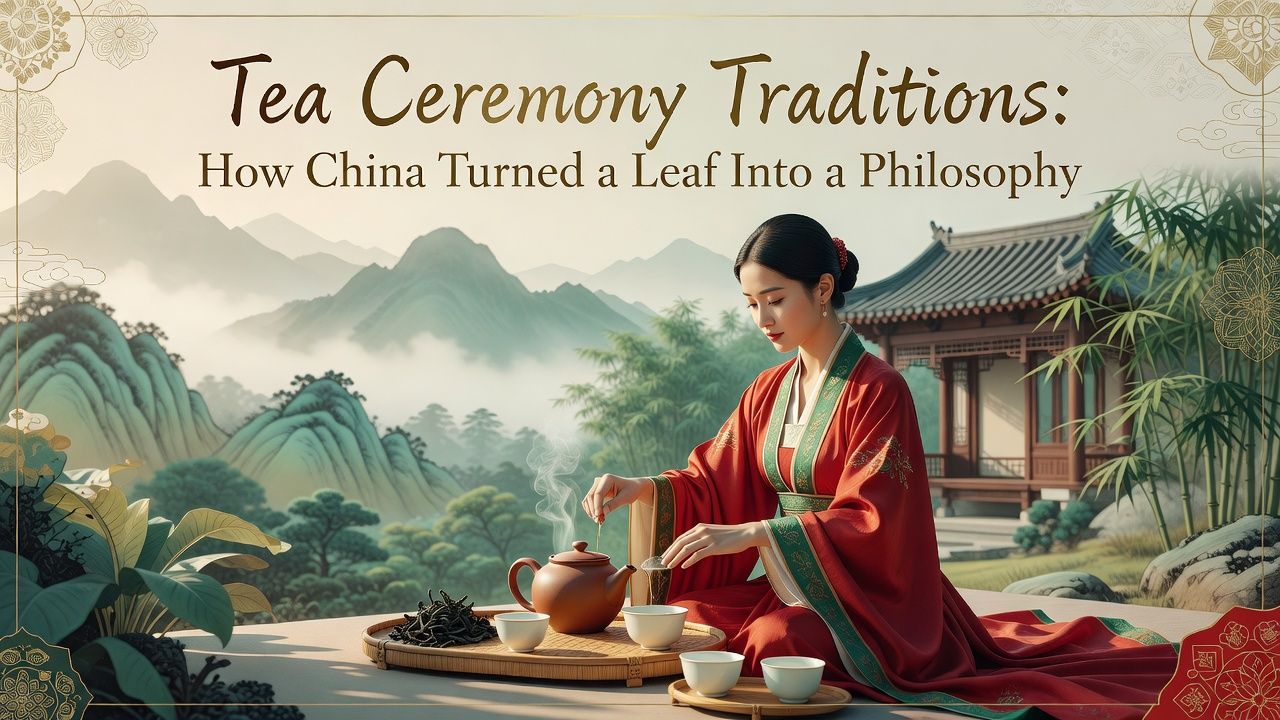
China’s signature tea ritual is gongfu cha — “tea made with skill” (the same gongfu as kung fu, meaning mastery earned through practice) — a brewing method perfected in the Chaoshan region and now the lingua franca of serious tea everywhere. Its logic inverts Western habits: instead of a large pot brewed once and long, gongfu uses a small vessel packed generously with leaves and infused many times for seconds each — so a single session unfolds as a sequence of eight, ten, fifteen tiny cups, each infusion subtly different, the tea telling its story chapter by chapter. The equipment is a pleasure in itself: a small Yixing clay teapot (whose porous purple clay seasons with use, which is why devotees dedicate one pot to one tea type) or a gaiwan — the lidded bowl that is Chinese tea’s Swiss Army knife — plus a fairness pitcher to equalize the brew before pouring, thimble-sized cups, and a slatted tea tray to catch the ritual’s generous spillage.
A session follows a graceful choreography that looks elaborate and is actually functional at every step: warm the vessels with hot water (temperature control); “awaken” the leaves with a first quick rinse that is poured off (rinsing and opening the leaf); then brew in short infusions, lengthening slightly as the leaves tire, pouring through the fairness pitcher so every guest’s cup is equal — hence the name. Water matters (soft, fresh, and crucially at the right temperature: cooler for delicate greens, near-boiling for oolongs and pu-erh), and so does attention: gongfu cha is deliberately unhurried, a structure for noticing — the aroma on the lid, the leaf unfurling, the way infusion four differs from infusion two. It can be as ceremonial as a formal demonstration or as casual as a Chaoshan family’s nightly table habit; the skill, not the solemnity, is the point. Compared with Japan’s famous tea ceremony — a codified, choreographed ritual centered on powdered matcha — the Chinese way is looser, more conversational, and centered on the leaf itself: less liturgy, more connoisseurship.
Tea as philosophy: the worldview in the cup
What elevated Chinese tea beyond refreshment was its adoption by the culture’s three great traditions, each finding its own meaning in the leaf. For Daoists, tea embodied harmony with nature — mountain water, wild leaf, the unforced patience of steeping — and the classical aesthetic of tea (simple wares, natural settings, few words) is Daoist to its bones. For Buddhists, tea was the meditation ally: monasteries planted China’s early tea gardens, monks spread the drink along with the dharma, and the saying chan cha yi wei — “Zen and tea are one taste” — still hangs in teahouses, compressing a whole theology of mindful presence into four characters. For Confucians, tea became the social lubricant of civilization: the medium of hospitality, the centerpiece of rituals from weddings (where couples serve tea to their elders as the ceremony’s emotional heart) to apologies to business courtesies, encoding respect in every pour.
This inheritance survives in living etiquette any traveler will meet. Tea is offered to every guest, always, and accepting is the courtesy; the host keeps cups filled, and the guest’s thanks is the two-finger tap on the table (a gesture born, legend says, of an incognito emperor’s companions bowing with their hands). Serving order honors age and rank; pouring for others before yourself is axiomatic; and a teapot’s spout, some traditionalists note, shouldn’t point at a guest. In business and family life alike, tea remains the neutral ground on which relationships are built — which is why the teahouse, not the bar, has been China’s default meeting place for a thousand years, and why the phrase “let’s drink tea” can mean anything from courtship to contract negotiation. The leaf, in short, became the culture’s way of saying: slow down, sit down, we are in relation now.
Where to drink it: a tea traveler’s itinerary
Tea makes a superb organizing thread for a China trip, because the great tea regions are also some of the country’s loveliest places. The classic pilgrimage begins in Hangzhou, where Longjing green tea grows in mist-terraced hills minutes from West Lake — visit the plantation villages, watch leaves pan-fired by hand in spring, and drink the harvest meters from where it grew. Chengdu offers the opposite pole: the teahouse as social carnival, where bamboo-chair courtyards like those in People’s Park have hosted mahjong, ear-cleaning, opera, and all-day tea-drinking for generations — the single best place on earth to understand tea as public life. Mount Wuyi in Fujian pairs UNESCO-listed gorge scenery with the cliff gardens of the rock oolongs; the Chaoshan region is gongfu cha’s homeland, where the ritual is simply how everyone drinks; and Yunnan’s tea mountains around Xishuangbanna hold ancient tea forests — some trees centuries old — where pu-erh begins its long life. Even Beijing joins the map with its grand old teahouses and the sprawling Maliandao tea market, a whole district of leaf merchants happy to brew endless samples.
| Destination | The tea experience | Best time |
|---|---|---|
| Hangzhou | Longjing villages & plantations; national tea museum; lakeside teahouses | Spring (pre-Qingming harvest, late Mar–Apr) |
| Chengdu | Classic people’s teahouses — tea as all-day social life | Any season |
| Mount Wuyi | Rock-oolong cliff gardens inside a UNESCO landscape; tastings at source | Spring & autumn |
| Chaoshan (Chaozhou) | Gongfu cha’s homeland — the ritual as daily life; Phoenix Dancong oolongs | Any season |
| Yunnan (Xishuangbanna) | Ancient tea-forest mountains; pu-erh villages & aging warehouses | Spring harvest; dry season Nov–Apr |
| Beijing | Historic teahouses; Maliandao tea market for tasting & buying everything | Any season |
Bringing the ceremony home
The best news about Chinese tea culture is how little it takes to begin: a single gaiwan (inexpensive, and the most versatile brewing tool ever designed), a few small cups, decent loose leaves, and water — the whole kit costs less than a restaurant dinner. Start with an approachable oolong like tieguanyin, which forgives beginner technique and rewards multiple infusions dramatically; use generous leaf, short steeps (start around 10–20 seconds, adding time as you go), and water just off the boil for oolongs (cooler, around 75–85°C, for greens so they don’t stew bitter). Then simply pay attention across the infusions — that’s the entire ceremony. Buy from specialist tea shops rather than supermarket dust, expect to taste before buying anywhere in the Chinese tradition (tastings are the culture, not a sales trick), and know that on tea’s health questions the sober summary from sources like the NCCIH and the Harvard Nutrition Source is pleasantly aligned with tradition: tea is a healthful daily drink rich in polyphenols, associated in research with various benefits, and best enjoyed as a pleasure rather than a medicine.
And pleasure — of a particular, deliberate kind — is what the whole tradition finally teaches. In a world of lidded cups drunk while walking, gongfu cha proposes something quietly radical: that a beverage can be an occasion; that pouring for another person is a small ceremony of respect; that the same leaves, met with attention, will tell you ten different things across ten infusions; that skill and patience make ordinary moments deeper. China turned a leaf into a philosophy by discovering that the way you do a small thing can carry everything — hospitality, harmony, presence, mastery. You don’t need the mountain, the antique Yixing pot, or the ceremony’s full choreography to receive that inheritance. You need leaves, hot water, small cups, and the willingness to sit down for the length of a few infusions. The rest, as two thousand years of tea masters would tell you, steeps in on its own.