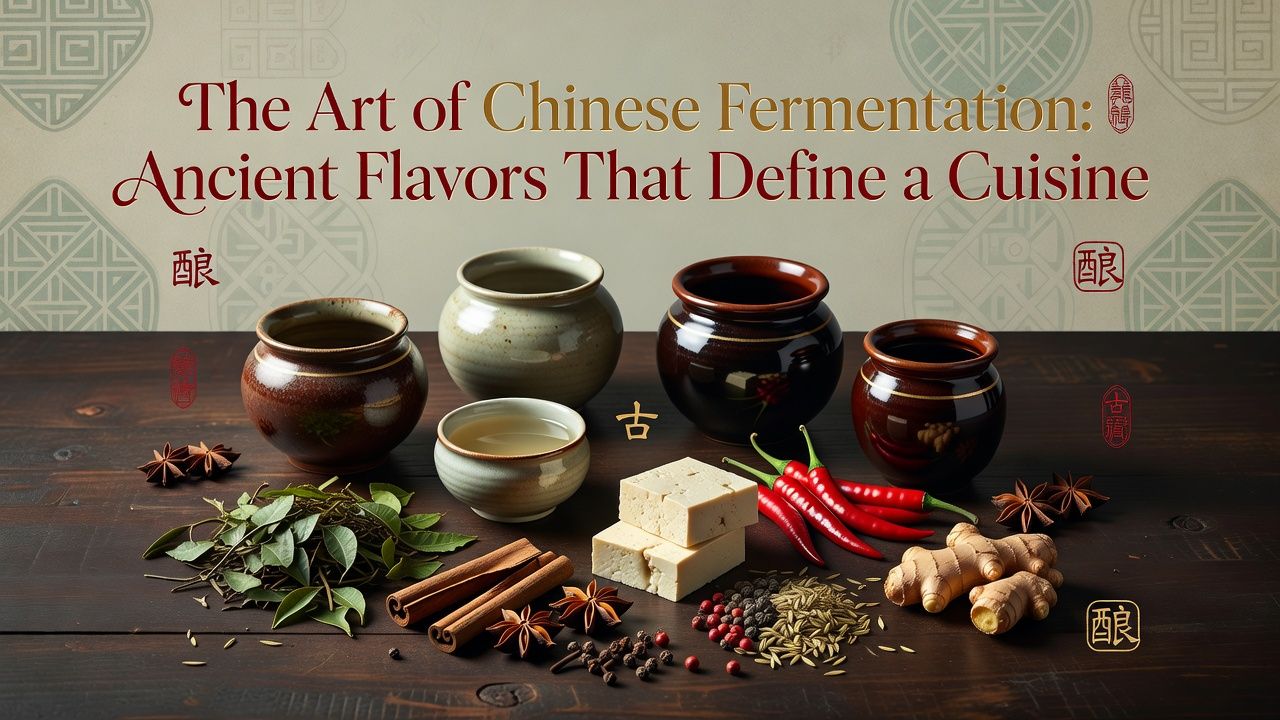
Food & Culinary Culture
Soy sauce, vinegar, tofu, wine, pickles, that mysterious deep savor in every great Chinese dish — nearly all of it is fermentation. Meet the invisible microbes that built one of the world’s great cuisines.
Ask what makes Chinese food taste the way it does, and most people will name ingredients — soy sauce, ginger, chili, garlic. But the deeper answer is a process: fermentation. That haunting savory depth in a bowl of noodles, the tang of a Sichuan pickle, the funk that makes black-bean sauce irreplaceable, the very existence of soy sauce and rice wine — all of it is the work of invisible microbes, molds and bacteria and yeasts that Chinese cooks learned to cultivate thousands of years ago, long before anyone knew a microbe existed. Fermentation is arguably the single most important technique in the Chinese kitchen, more foundational than the wok or the cleaver, because it produces the flavor grammar — the umami, the sourness, the aromatic complexity — on which everything else is built. Remove fermented ingredients from Chinese cooking and it doesn’t just lose some dishes; it loses its voice.
This is not a fringe or artisanal story — it’s the mainstream of one of humanity’s oldest and most sophisticated fermentation traditions. China was fermenting soybeans into paste and sauce over two thousand years ago, brewing rice wine before recorded history, and pioneering the use of cultivated mold cultures — the ingenious qu starter — that underpins soy sauce, vinegar, wine, and more, a technology later carried to Japan and Korea where it seeded miso, sake, and their own great traditions. Modern food science has caught up with what these cooks knew empirically, and the current wellness interest in fermented foods and gut health (covered soberly by sources like the Harvard Nutrition Source) has only made the tradition newly fashionable. This guide is the field manual: what fermentation actually does, the essential fermented foods that define Chinese cooking, the science beneath the craft, and how to start exploring it yourself.
What fermentation is, and why China mastered it
At its simplest, fermentation is controlled transformation by microorganisms: bacteria, yeasts, or molds break down a food’s sugars, proteins, and starches into new compounds — acids, alcohols, and above all the glutamates and other molecules our tongues read as umami, the deep savory “fifth taste.” Humans everywhere stumbled onto fermentation as a preservation method (acids and alcohol keep spoilage microbes at bay), but the flavor was the addictive part, and few cultures pursued it as systematically as China. The reason is partly necessity — a vast agricultural civilization needed to store harvests and stretch scarce protein — and partly genius: Chinese cooks made a conceptual leap thousands of years ago by learning to cultivate specific molds deliberately, creating the qu (starter culture) that let them ferment reliably rather than by accident, effectively domesticating microbes as surely as they domesticated rice.
That qu starter — grains inoculated with cultivated molds like Aspergillus — is the quiet hero of the entire tradition, the master key that unlocks soy sauce, rice wine, vinegar, and fermented bean pastes alike, because the molds’ enzymes pre-digest tough soybeans and grains into the sugars and amino acids that other microbes then transform into flavor. The technology was so powerful it became a foundation of East Asian cuisine broadly; Japanese kōji, the basis of miso, sake, and soy sauce, descends from the same Chinese lineage. Understanding this single concept — cultivated mold cultures unlocking grains and beans — demystifies most of Chinese fermentation at a stroke, and reveals the tradition for what it is: not folk superstition but an empirically refined biotechnology, run for millennia in earthenware jars.
The pantry of transformation: essential fermented foods
Once you know to look for it, fermentation reveals itself everywhere in the Chinese pantry — often in the exact ingredients that seem most basic. Here are the pillars, the invisible architecture of Chinese flavor:
| Ingredient | What it is | What it does in the kitchen |
|---|---|---|
| Soy sauce 酱油 | Fermented soybeans & wheat, brewed for months | The universal seasoning; light for salt/flavor, dark for color & depth |
| Rice vinegar 醋 | Fermented rice (or sorghum), then soured by acetic bacteria | Balancing tang; black (Zhenjiang) vinegar is a complex, near-balsamic star |
| Doubanjiang 豆瓣酱 | Fermented broad-bean-and-chili paste (Pixian is the famous origin) | The soul of Sichuan cooking — mapo tofu, twice-cooked pork |
| Douchi 豆豉 | Fermented (often black) soybeans, salty and pungent | Black-bean sauce’s backbone; deep savory funk |
| Fermented tofu 腐乳 | Tofu cured with mold & brine into a soft, intense “cheese” | A little transforms greens, congee, marinades — umami bomb |
| Suan cai / pao cai 酸菜/泡菜 | Salt- or brine-fermented vegetables (mustard greens, cabbage, etc.) | Sour, crunchy; Sichuan & Northeastern kitchens depend on them |
| Huangjiu / rice wine 黄酒 | Fermented rice “yellow wine” (Shaoxing is the classic) | Cooking wine that deepens braises & marinades; also drunk warmed |
| Stinky tofu & friends 臭豆腐 | Tofu fermented in pungent brine (and other “stinky” specialties) | The tradition’s boldest edge — smells fierce, tastes savory-mellow |
The revelation in this table is how much of “just cooking” is really fermentation. That stir-fry seasoned with soy, splashed with Shaoxing wine, and finished with a touch of black vinegar is a dish built almost entirely on fermented foundations — three separate microbial transformations layered in seconds. This is why Chinese food achieves its characteristic depth so quickly: the slow work was done in advance, in the jar and the brewing yard, and the wok merely assembles the pre-made complexity. And the regional cuisines are, in large part, fermentation dialects — Sichuan speaks doubanjiang and pickles, Cantonese speaks douchi and fermented tofu, the northeast speaks suan cai, each region’s flavor signature encoded in which microbes it cultivates.
The bold frontier: fermentation’s acquired tastes
Chinese fermentation also produces some of the world’s most notorious “acquired tastes,” and understanding them turns intimidation into appreciation. Stinky tofu (chou doufu) is the famous ambassador — tofu fermented in a pungent brine until it smells, frankly, alarming, then usually fried and sauced — but the smell-taste gap is the whole joke: the aroma is fierce, the flavor mild, savory, and mellow, and its devotees (a vast number, at markets nationwide) consider the smell part of the pleasure, like strong cheese or durian. The same principle governs other regional specialties — Anhui’s “stinky” fermented mandarin fish, various fermented vegetable and bean preparations — where controlled funk is prized rather than tolerated. The cross-cultural lesson is worth holding onto: Western food has its own beloved fermented pungency in blue cheese, aged salami, and fish sauce, so the reaction to Chinese “stinky” foods is cultural familiarity, not objective disgust. What smells like a dare is, to those raised on it, simply flavor at full volume.
A crucial distinction underlies all of it, and it separates cuisine from spoilage: fermentation is controlled microbial transformation by beneficial organisms, not rot. Traditional Chinese fermentation methods evolved over millennia with built-in safety logic — salt concentrations, acidity, alcohol, and specific cultivated cultures that crowd out harmful microbes — which is why properly made fermented foods are safe and have nourished billions. This matters for the home fermenter especially: successful fermentation isn’t a free-for-all but a discipline of the right salt, the right conditions, and cleanliness, and learning it means learning to distinguish the good funk (sour, alcoholic, savory, appetizing) from genuine spoilage (fuzzy off-colored mold, putrid smells, sliminess — discard, don’t taste). Reputable, science-based guidance on safe fermentation and preservation is freely available from the National Center for Home Food Preservation, and beginners should lean on it rather than guesswork.
The science and the wellness angle, honestly
Modern food science has vindicated the tradition’s empirical wisdom with satisfying precision. Fermentation genuinely does three valuable things: it preserves (acids, salt, and alcohol inhibit spoilage, the original reason it mattered in a pre-refrigeration world); it transforms flavor, generating the glutamates and aromatic compounds that create umami and complexity impossible to achieve any other way; and it can improve nutrition and digestibility, since microbial action breaks down hard-to-digest components, can increase the availability of certain nutrients, and produces beneficial compounds. Some fermented foods also contain live beneficial bacteria — the “probiotic” angle driving today’s gut-health enthusiasm — though it’s worth an honest caveat: many Chinese fermented staples are cooked, heavily salted, or brewed in ways that reduce live cultures, so soy sauce and doubanjiang are flavor powerhouses rather than probiotic supplements, while lightly fermented pickles retain more live culture.
The sober framing, echoed by nutrition resources like the NIH, is that fermented foods are a genuinely worthwhile and delicious part of a varied diet, associated with real benefits, without needing the miracle-cure claims that sometimes attach to them — and with one practical asterisk relevant to Chinese fermentation specifically: many of these ingredients are high in salt, so soy sauce, fermented bean pastes, and salted pickles are best used as the potent seasonings they are, in the modest amounts the cuisine actually intends, rather than poured freely. Enjoyed that way — as concentrated flavor built by microbes over months and deployed by the spoonful — Chinese fermented foods are exactly what they’ve always been: one of the healthiest and most flavorful traditions in world cooking, no supplement marketing required.
Exploring it yourself: from the shelf to the jar
You don’t need to ferment anything to start appreciating this art — the first step is simply buying and cooking with the traditional ingredients rather than their industrial shortcuts. Seek out naturally brewed soy sauce (the label will say “naturally brewed”; it’s worlds better than the chemically hydrolyzed kind), real Zhenjiang black vinegar, genuine Pixian doubanjiang, Shaoxing wine, and a jar of fermented tofu — and taste each one alone to learn its voice before cooking with it. A single well-stocked shelf of fermented staples is the biggest upgrade most home Chinese cooking can receive, because it swaps flat approximations for the deep flavors the dishes were designed around. From there, a few classic dishes teach fermentation’s role directly: mapo tofu (doubanjiang and douchi), a black-bean stir-fry (douchi), morning greens brightened with a cube of fermented tofu, any braise deepened with Shaoxing wine.
| Level | Where to start |
|---|---|
| Taste | Buy naturally-brewed soy, black vinegar, doubanjiang, fermented tofu; taste each alone |
| Cook | Make mapo tofu, black-bean dishes, Shaoxing-braises — feel what fermentation contributes |
| Try the bold | Sample stinky tofu at a market; push past the aroma to the flavor |
| Ferment (beginner) | Simple salt-brined Sichuan-style pickles (pao cai) — using tested, safe recipes |
For the genuinely bitten, home fermentation is deeply rewarding, and the gentlest entry is a simple brined vegetable pickle in the Sichuan pao cai style — vegetables in a salt brine, transformed by wild bacteria into something sour and alive within days — using a tested recipe and the safety fundamentals (correct salt ratio, clean equipment, submerged vegetables, and the discard-if-in-doubt rule for any off mold or smell) from a reliable source like the NCHFP. Whether you ever pack a jar or simply upgrade your pantry, the deeper reward is a new way of tasting: once you can perceive fermentation’s fingerprint — the umami depth, the balancing sourness, the aromatic funk — Chinese food becomes legible in a way it never was, and you begin to taste the invisible collaborators, the molds and bacteria and yeasts, that have been quietly co-authoring one of the world’s greatest cuisines for three thousand years. That is the real art of Chinese fermentation: not a technique you watch, but a flavor you finally learn to read.