Travel & Destinations
The misty peaks in classical Chinese scroll paintings aren’t stylized fantasy — they’re real places you can stand in. Meet the karst pinnacles, sacred mountains, and rainbow ranges that shaped an entire artistic tradition.
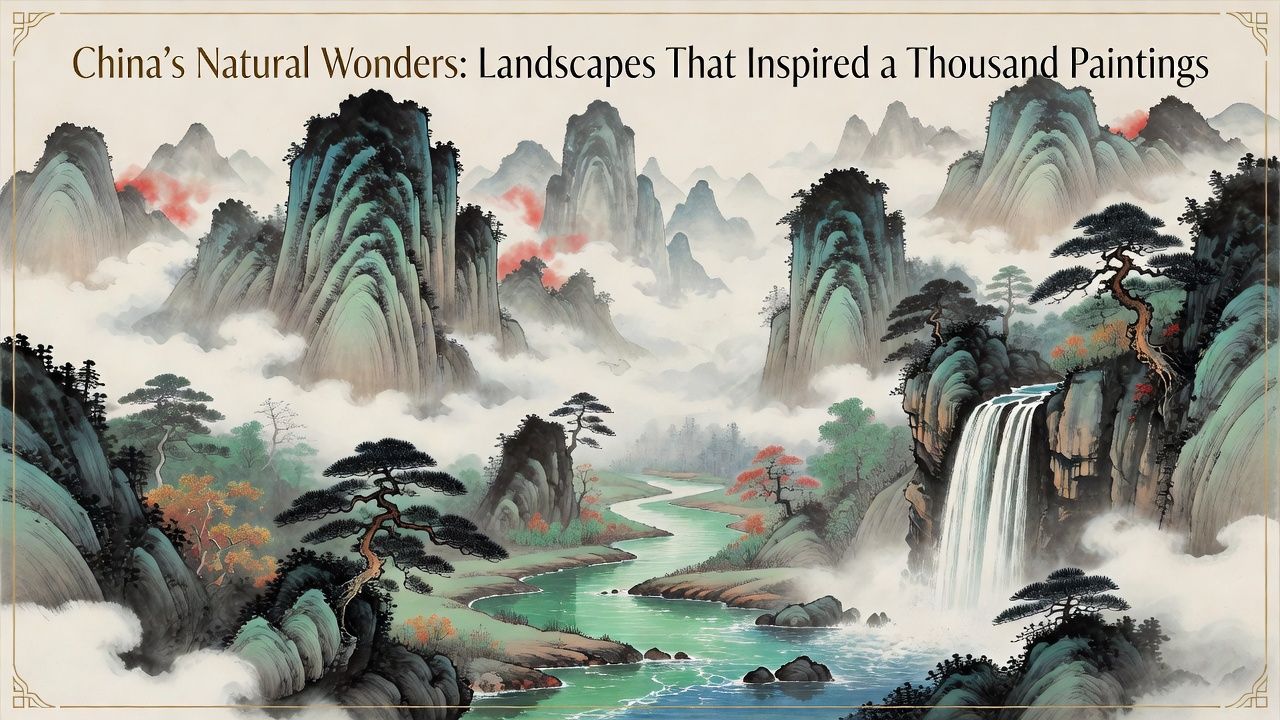
Anyone who has seen a classical Chinese landscape painting knows the imagery: jagged peaks rising like teeth from a sea of cloud, waterfalls threading down vertical cliffs, a lone pavilion dwarfed by mountains, everything half-dissolved in mist. For centuries, Western viewers assumed this was stylization — a poetic exaggeration, mountains as imagined rather than seen. It is not. Those landscapes are startlingly literal portraits of real Chinese scenery, and the first time you stand among the granite spires of Huangshan at dawn, watching cloud seas swirl around pines clinging to impossible crags, you realize the painters were practically photographers. China’s terrain produced some of the most dramatic landscapes on earth — and because Chinese civilization revered mountains as sacred and wove nature into the heart of its philosophy and art, those landscapes became not just scenery but the wellspring of an entire aesthetic tradition.
This deep bond between land and art is what makes China’s natural wonders unlike sightseeing anywhere else: you are not just visiting beautiful places but visiting the sources of a civilization’s imagination, often up the same stone stairways pilgrims and poets climbed a thousand years ago. Many of these landscapes are protected on the UNESCO World Heritage List, several as rare “mixed” sites honored for both natural grandeur and cultural meaning — because in China the two were never separated. This guide tours the greatest of them: the karst pinnacle-lands, the sacred mountains, the alpine water-worlds, and the geological oddities, with honest notes on what each is really like to visit. Bring good shoes and a tolerance for stairs; China’s most sublime scenery rarely comes without a climb.
Karst country: the stone forests and river gorges of the south
Southern China is the world capital of karst — the landscape that forms when rainwater slowly dissolves limestone over millions of years, leaving behind pinnacles, caves, sinkholes, and towers. Its most famous expression is the region around Guilin and Yangshuo in Guangxi, where thousands of humpbacked limestone peaks rise abruptly from flat green paddies and the mirror-calm Li River, creating the scenery printed on China’s own banknotes and reproduced in ten thousand ink paintings. A bamboo-raft or boat drift down the Li between Guilin and Yangshuo remains one of travel’s great slow pleasures — peak after peak sliding by in the mist, water buffalo in the shallows, cormorant fishermen on the banks — and the smaller towns and rivers around Yangshuo (best explored by bicycle) deliver the same magic with a fraction of the crowds. This is postcard China made real, and it earns the cliché.
Karst wonders multiply across the southwest. The UNESCO-listed “South China Karst” gathers several sites, including Yunnan’s Stone Forest (Shilin), a surreal maze of upright limestone blades where you wander among stone “trees,” and the caves and towers of Guizhou — a province that also hides Asia’s tallest waterfall at Huangguoshu, thundering wide across a karst cliff. Further afield, the same forces carved spectacular cave systems, natural bridges, and the deep river gorges of the region. What unites these places is the peculiar magic of karst: scenery that feels invented, almost architectural, as if giants had been at work, and light that turns theatrical as mist rises off the limestone at dawn and dusk. For photographers and painters alike, karst country is China at its most dreamlike — and its most literally paintable.
The sacred mountains: where landscape meets worship
No landscapes are more central to Chinese culture than its sacred mountains, which are simultaneously natural wonders, pilgrimage destinations, and open-air museums of temples, carved inscriptions, and poetry. Chief among them for sheer scenic drama is Huangshan (Yellow Mountain) in Anhui — the mountain that, more than any other, taught Chinese painters how to see. Its granite peaks, gnarled pines growing straight from bare rock, hot springs, and above all its famous “sea of clouds” (a cloud inversion that turns the summits into islands floating on white) are the direct visual source of classical landscape art; a UNESCO mixed site, it is best experienced by staying overnight on the summit to catch both sunset and the dawn cloud-sea, when the crowds thin and the mountain becomes the scroll painting come alive. The stairways are legendary and relentless, though cable cars ease the ascent.
China’s sacred mountains fall into revered groupings — the Five Great Mountains of the Daoist tradition and the Four Sacred Mountains of Buddhism — each climbed by pilgrims for two millennia. Mount Tai in Shandong, the most exalted of the Daoist five, has been ascended by emperors performing sacrifices since antiquity; its stone stairway of over six thousand steps, lined with temples and cliff carvings, makes the climb a walk through history. Mount Emei in Sichuan, a Buddhist holy mountain, rises to a “Golden Summit” often wreathed in cloud and pairs (in its UNESCO listing) with the colossal Leshan Giant Buddha carved nearby into a river cliff. Others — Hua Shan with its vertigo-inducing plank walks, Wutai’s temple-filled valleys, Wudang’s Daoist monasteries and martial-arts heritage — each blend geology and devotion. To climb any of them is to understand something no museum can teach: that in China, a mountain was never just scenery. It was where earth touched heaven, and the temples, poems, and worn steps prove people have felt that here for a very long time.
| Wonder | Where | Why go — and what it’s like |
|---|---|---|
| Li River karst | Guilin / Yangshuo (Guangxi) | The banknote landscape; river cruise + cycling. Easy, iconic, deservedly popular |
| Huangshan | Anhui | The painters’ mountain; cloud seas & pines. Stay overnight for dawn; steep |
| Zhangjiajie (Wulingyuan) | Hunan | Thousands of quartzite pillars (the “Avatar” mountains); glass bridges & lifts |
| Jiuzhaigou & Huanglong | Sichuan | Turquoise-tiered lakes & travertine pools; boardwalks. Stunning autumn color |
| Mount Tai / Mount Emei | Shandong / Sichuan | Sacred pilgrim mountains; temples, carvings, stairways of history |
| Zhangye Danxia | Gansu | “Rainbow mountains” of striped sandstone; boardwalk viewpoints, best at sunset |
| Stone Forest & Yuanyang terraces | Yunnan | Karst blade-maze; and sculpted rice terraces mirroring the sky at dawn |
Water worlds and rock oddities
Some of China’s most jaw-dropping scenery involves water and stone in stranger combinations. In northern Sichuan, the UNESCO-listed valleys of Jiuzhaigou and Huanglong hold water so vividly colored it looks digitally enhanced — a staircase of lakes in impossible turquoise, teal, and cobalt, tinted by mineral deposits and framed (in autumn) by blazing foliage, with Huanglong adding terraced travertine pools like golden rice paddies of stone. Boardwalks lace both, making the wonders accessible; the color peaks under bright autumn sun. Far to the west, the Zhangjiajie region in Hunan (Wulingyuan) presents something else entirely: thousands of sheer quartzite-sandstone pillars, several hundred meters tall, rising from subtropical forest into perpetual mist — the towering columns that helped inspire the floating peaks of the film Avatar, now toured via dizzying elevators, cable cars, and the world’s longest and highest glass bridges for those with the nerve.
Then there are the geological curiosities that seem almost too whimsical to be natural. The Zhangye Danxia landforms in Gansu — the “rainbow mountains” — are hills painted in horizontal bands of red, orange, yellow, and green by layers of mineral-rich sandstone tilted and eroded over millions of years; boardwalk viewpoints and the low light of sunset make them glow. Yunnan’s rice terraces at Yuanyang, though shaped by human hands over centuries, belong on any list of the country’s most beautiful sights: a mountainside sculpted into thousands of curving flooded terraces that mirror the sky at dawn and dusk, a landscape that is agriculture elevated to art. Add the desert-and-oasis drama of the Silk Road’s dunes, the grasslands of Inner Mongolia, and the vast wild plateaus of the west, and China’s range of natural spectacle rivals any country on earth — a diversity that reflects its continental scale.
Why the landscapes became the art
Understanding why these landscapes shaped Chinese art enriches every visit. In Chinese thought — especially Daoism — mountains and water (the two characters that together, shanshui, literally form the word for “landscape painting”) were not mere scenery but the visible expression of cosmic forces, places where the energy of the universe was concentrated and where humans could commune with something larger than themselves. Painters did not aim to copy a scene photographically; they sought to capture its spirit, its essential energy, often depicting humans as tiny figures dwarfed by vast nature — a deliberate philosophical statement about humanity’s humble place within the cosmos, the opposite of the human-centered tradition of much Western art. Poets climbed the same peaks and wrote verses still memorized today; the mountain, the poem, and the painting became a single cultural act.
This is why so many Chinese natural sites carry the extra layer that pure wilderness elsewhere lacks: cliff-carved poems, temples at the summits, pavilions positioned at the exact spot a famous painter once sat, place-names drawn from legend. When you climb Huangshan and see a pine that appears in a thousand-year-old scroll, or stand where Li Bai wrote of a waterfall “flying straight down three thousand feet,” the landscape and the culture fuse. Museums like the Metropolitan Museum of Art hold the paintings these mountains inspired, and seeing the real place after the painting — or the painting after the place — completes a circuit that has been running for over a millennium. China’s natural wonders, uniquely, come with their own artistic commentary already attached.
Planning your landscape journey
A few practical truths make China’s natural wonders far more enjoyable. Timing is everything: these are among China’s most beloved domestic destinations, so avoid the national holidays (October’s Golden Week and the Lunar New Year period especially), when trails and cable cars overflow; aim for shoulder seasons, with autumn the crown for Jiuzhaigou’s color and clear mountain air, and spring lovely for the karst south. Expect infrastructure, for better and worse: China has developed its scenic areas heavily — cable cars, elevators, boardwalks, glass bridges, and shuttle-bus systems are the norm, which makes even dramatic scenery accessible to almost everyone but also means the wilderness is managed rather than raw. Embrace the boardwalks where they exist (they protect fragile terrain) and seek the quieter hours and corners for solitude — arriving at opening or staying overnight on a summit transforms the experience.
| Practical matter | What to know |
|---|---|
| When to go | Autumn & late spring; avoid Golden Week (early Oct) & Lunar New Year crowds |
| Fitness & stairs | Sacred mountains mean serious climbing; cable cars help; wear real shoes |
| Altitude | Jiuzhaigou and western sites sit high; ascend gradually, hydrate |
| Crowd tactics | First entry of the day, overnight summit stays, and less-famous corners |
| Tickets | Major parks require advance online booking with passport; caps sell out |
However you plan it, the deepest reward of traveling China’s landscapes is the recognition that keeps recurring: I have seen this before. In the cloud-wreathed pinnacle, the pine on the bare crag, the waterfall down the vertical cliff, the tiny pavilion beneath the vast peak, you meet the images that a civilization spent two thousand years painting, writing, and worshipping — and you understand, standing in them, that the paintings were true all along. China’s mountains and waters made its art, its poetry, and much of its philosophy; to walk among them is to visit the source. Save the great sites for the quiet hours, climb the sacred stairs even when your legs protest, stay for one summit dawn — and let the landscapes that inspired a thousand paintings inspire you, exactly as they were meant to, from inside the scroll.