Travel & Destinations
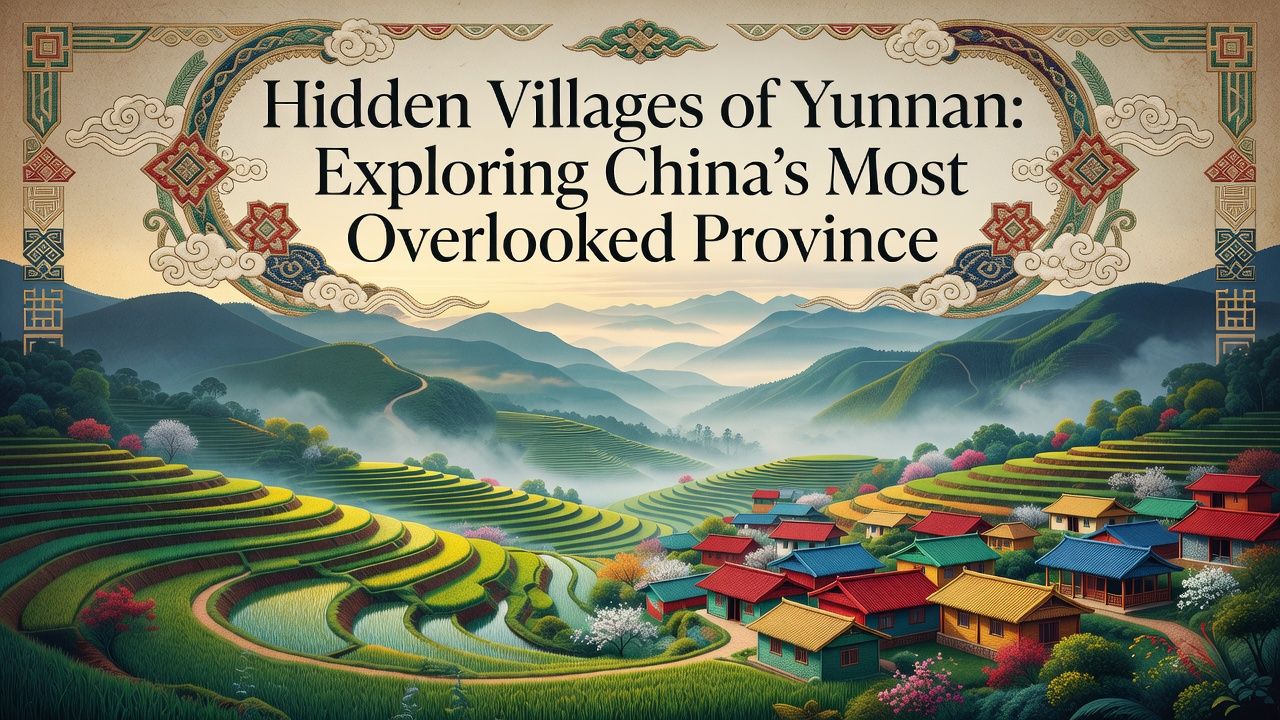
Snow peaks and rice terraces, ancient tea forests and mud-brick villages, twenty-five ethnic groups and a slower way of life — Yunnan is the China most travelers never reach, and the one many love most.
In China’s far southwest, wedged against Tibet, Myanmar, Laos, and Vietnam, lies a province that feels like several countries stitched together. Yunnan — the name means “south of the clouds” — rises from steamy tropical borderlands to Himalayan snow peaks over 6,000 meters, and packs into that vertical range an astonishing diversity of landscapes, climates, and peoples. It is home to around twenty-five of China’s officially recognized ethnic minorities, more than any other province, so that a single day’s travel can pass through Bai, Naxi, Yi, Dai, Tibetan, Hani, and Mosuo communities, each with its own language, dress, architecture, and traditions. For travelers who have “done” Beijing, Xi’an, and Shanghai and want to discover a different China — slower, more rural, breathtakingly scenic, and profoundly diverse — Yunnan is the great reward, and its villages are its soul.
The famous stops — the old towns of Lijiang and Dali, the Shangri-La highlands — are justly popular and worth visiting, but Yunnan’s deepest magic lives in the villages beyond them: ancient tea-growing hamlets, terraced mountainsides sculpted over centuries, Tibetan settlements below sacred peaks, and communities where traditional life continues much as it has for generations. This guide maps that hidden Yunnan — the regions and villages worth seeking, the peoples who make them extraordinary, and how to travel respectfully and well in a place where tourism can bless or burden fragile communities. Several of Yunnan’s landscapes and old towns carry UNESCO recognition, browsable on the World Heritage List, but the province’s real treasure is intangible: the sense, increasingly rare in modern China, of places and ways of life that time has touched gently.
The classic old towns — and how to see them well
Yunnan’s tourism heart is the corridor of old towns in the northwest, and while they draw crowds, they remain genuinely beautiful and make ideal bases for reaching quieter places. Dali, on the shore of the vast Erhai Lake beneath the Cangshan mountains, is the historic center of the Bai people; its walled old town is atmospheric (if touristy at its core), but the real pleasure is cycling the lakeshore and exploring the Bai villages ringing the water, with their distinctive whitewashed, painted-gable houses and marble craft traditions. Lijiang, a UNESCO-listed old town of the Naxi people, is famous for its canal-laced lanes, cobbled streets, and the snow-capped backdrop of Jade Dragon Snow Mountain — wonderful in the early morning before the day-trippers arrive, and a springboard to Naxi villages and the dramatic Tiger Leaping Gorge nearby. Both towns reward the same strategy: enjoy the old town at dawn and dusk, sleep in a courtyard guesthouse, and spend your days in the surrounding countryside where the crowds thin to nothing.
Further north, the air thins and the culture shifts to Tibetan: Shangri-La (officially renamed from Zhongdian to claim the fictional paradise) sits at over 3,200 meters on the edge of the Tibetan plateau, with a grand monastery, prayer flags snapping over grasslands, and a gateway feel to the high country beyond. Beware the altitude here and ascend gradually. And between these hubs runs some of China’s most spectacular trekking — above all Tiger Leaping Gorge, one of the world’s deepest canyons, where a two-day high trail traverses cliffs above the roaring Jinsha River, passing Naxi guesthouses and terraced hamlets, delivering the kind of village-and-mountain immersion that is Yunnan at its finest. The old towns, in short, are not the destination but the doorway; the province opens the moment you step past their gates.
The truly hidden Yunnan: villages worth the journey
Beyond the famous towns lie the regions that reward travelers willing to go further and slower — the hidden Yunnan of the article’s title:
| Region | What makes it special | Peoples & scene |
|---|---|---|
| Yuanyang rice terraces | UNESCO-listed mountainsides sculpted into thousands of flooded terraces mirroring the sky at dawn | Hani & Yi villages; stay overnight for sunrise/sunset light |
| Xishuangbanna | Tropical south on the Mekong; rainforest, tea forests, Southeast Asian feel | Dai people & many others; temples, water-splashing festival, ancient tea mountains |
| Nuodeng | A thousand-year-old Bai salt-well village of tiered wooden houses on a hillside | Bai; famed for ham, ancient salt trade, deeply traditional feel |
| Shaxi | A restored ancient market town on the old Tea Horse Road, between Dali & Lijiang | Bai; cobbled square, Friday market, tranquil valley — Lijiang without the crowds |
| Lugu Lake & Mosuo villages | A pristine alpine lake on the Sichuan border, ringed by traditional villages | Mosuo, known for a distinctive matrilineal culture; serene, remote |
| Nujiang & Deqin | Deep Himalayan valleys; the sacred Meili Snow Mountain (Kawagarbo) | Tibetan, Lisu & others; remote hamlets, monasteries, serious mountains |
Two of these deserve special emphasis for the village-seeker. The Yuanyang rice terraces are among the most beautiful human-made landscapes on earth — carved over some 1,300 years by the Hani people into curving flooded steps that mirror sunrise and sunset in a thousand shades — and the reward comes from staying in a terrace village overnight to catch the golden light, when the mountainside turns to liquid mirror. And Shaxi is the quiet traveler’s secret: a lovingly restored caravan town on the ancient Tea Horse Road (the trade route that carried tea from Yunnan to Tibet), with a cobbled theater square, a lively weekly market drawing surrounding villagers in traditional dress, and the unhurried valley atmosphere that Lijiang lost to fame — arguably the single best base for experiencing old Yunnan without the crowds.
Yunnan’s peoples: the province’s true wonder
Yunnan’s landscapes are magnificent, but its ethnic and cultural diversity is what makes it singular — roughly a third of the population belongs to minority peoples, and the province is a living mosaic of languages, faiths, architecture, dress, festivals, and cuisines. The Bai around Dali are known for their whitewashed painted houses, marble, and tie-dye craft; the Naxi of Lijiang preserve the world’s only living pictographic script (the Dongba writing) and a haunting classical music tradition; the Dai of the tropical south, Theravada Buddhists culturally akin to their Thai and Lao neighbors, celebrate the joyous Water-Splashing Festival; the Hani engineer the Yuanyang terraces; the Tibetans of the northwest bring monasteries and highland herding culture; and the Mosuo of Lugu Lake maintain a distinctive matrilineal social structure that has long fascinated visitors. Each group offers its own window into a way of life, and encountering them — respectfully — is the heart of Yunnan travel.
This richness invites a crucial note on responsible travel, because cultural tourism carries real ethical weight. These are living communities, not attractions staged for visitors, and the difference between enriching and exploitative travel lies in attitude and behavior. Always ask before photographing people (a smile and a gesture usually suffice; accept “no” gracefully), and never treat anyone as a photo prop. Support communities directly by staying in locally owned guesthouses, eating in family restaurants, and buying genuine local crafts from their makers rather than mass-produced souvenirs. Dress and behave modestly at temples, festivals, and sacred sites, and follow local etiquette when you’re a guest in someone’s home or village. Learn a little — a few words, the basics of a group’s customs — and approach with humility and curiosity rather than a checklist. Done well, your visit brings welcome income and genuine cultural exchange; done carelessly, it reduces people to spectacle. Yunnan rewards the traveler who comes as a respectful guest.
Eating Yunnan: a cuisine apart
Yunnan’s food is one of China’s most distinctive and least-known regional cuisines, shaped by the province’s biodiversity, subtropical-to-alpine range, and ethnic variety. This is China’s mushroom capital — wild fungi of dozens of varieties fill summer markets and hotpots, prized nationwide (and eaten with local care, since some require proper cooking). It’s a rare corner of China that embraces dairy, with the Bai grilling and frying goat’s-milk cheese. Fresh herbs, edible flowers, and wild vegetables appear with a Southeast Asian abundance that reflects Yunnan’s borderland position; the famous “crossing-the-bridge rice noodles” arrive as a ritual of a scalding broth cooked at the table by the diner; Dai cuisine brings lemongrass, sour and spicy notes, and food grilled in banana leaves; and the province’s Pu’er and tea-mountain regions produce the celebrated aged pu-erh tea. Even the coffee is notable — Yunnan has quietly become China’s coffee-growing heartland. To eat across Yunnan is to taste a cuisine that feels, like the province itself, poised between China and its tropical neighbors.
Village and market eating is where this shines: seek out the local morning markets (a sensory highlight everywhere in Yunnan), family guesthouse kitchens serving what the household eats, and regional specialties tied to each area — Nuodeng’s cured ham, Dali’s fish from Erhai Lake, Xishuangbanna’s Dai grilled dishes, wild-mushroom hotpot in season. General travel-food sense applies as anywhere — favor freshly cooked and busy stalls, and the standard guidance from the CDC’s travel pages covers the basics — but Yunnan’s food is a highlight rather than a hazard, and eating locally is also one of the best ways to support the communities you visit.
Planning a Yunnan journey
Yunnan rewards slow travel, and the biggest mistake is rushing it — the province’s scale, mountain roads, and the whole point of its unhurried atmosphere all argue for depth over breadth. A first trip of ten days to two weeks might focus on the accessible northwest circuit (Kunming → Dali → Shaxi → Lijiang → Shangri-La, with Tiger Leaping Gorge along the way), while more time opens the harder-to-reach jewels — Yuanyang’s terraces to the south, tropical Xishuangbanna, or the deep Himalayan valleys of the far northwest. Getting around has grown easier: the capital Kunming is well-connected by air and high-speed rail, internal flights and improving rail links bridge the longer distances, and buses reach the villages, though a hired car with driver or a small-group tour eases the remote routes considerably. Season matters — spring and autumn are ideal, Yuanyang’s terraces are most beautiful when flooded (roughly winter into spring), summer brings rain but also the mushroom bounty, and the high northwest is cold and can be snowbound in winter.
| Trip focus | Route | Time |
|---|---|---|
| Classic northwest | Kunming → Dali → Shaxi → Lijiang → Tiger Leaping Gorge → Shangri-La | 10–14 days |
| Terraces & south | Kunming → Yuanyang terraces → (fly) Xishuangbanna tropics & tea mountains | 8–12 days |
| Deep & remote | Add Lugu Lake, Nuodeng, or the Nujiang/Deqin Himalayan valleys | 2–3 weeks |
| Practical notes | Watch altitude in the northwest; carry cash for villages; check current access for border/remote areas; go slow | |
Yunnan asks more of a traveler than China’s headline cities — more time, more patience, more willingness to travel rough roads and meet the unfamiliar — and returns more in kind. This is the China of snow peaks and rice terraces, of twenty-five peoples and a thousand villages, of pu-erh tea forests and Tibetan monasteries and Dai temples all within one province’s borders, where an older, slower, more diverse way of life persists in the folds of extraordinary landscape. Come as a respectful guest, stay in the villages, eat what the households eat, ask before you photograph, go slowly enough to actually arrive — and Yunnan will show you the China that most visitors, hurrying between the famous sights, never even know is there: south of the clouds, and well worth the journey to reach it.