Arts & Traditions
Acupuncture, herbal formulas, qi, and a 2,000-year-old theory of the body — TCM shapes daily life for a fifth of humanity. Here’s a clear, balanced look at what it is, where it comes from, and what science actually says.
Traditional Chinese Medicine (TCM) is one of the world’s oldest continuously practiced healing systems, developed over two thousand years and still woven deeply into daily life across China and much of East Asia today. For a fifth of humanity, its concepts are simply common sense: foods classified as “heating” or “cooling,” herbal soups brewed for the season, acupuncture and cupping and massage as ordinary options alongside modern hospitals. TCM is a genuine cultural and historical phenomenon of enormous scale and endurance, and understanding it is part of understanding China. At the same time, it is a subject where cultural respect and scientific scrutiny both matter, and where it’s easy to slip into either uncritical enthusiasm or dismissive contempt — neither of which serves a curious reader well.
This guide aims for the balanced middle: it explains TCM as a cultural and historical tradition — its core concepts, its main practices, its living role — while being clear and honest about the state of scientific evidence, which varies enormously across TCM’s many components. Crucially, this is an informational and cultural article, not medical advice: it does not recommend TCM for treating any condition, and the single most important message throughout is that anyone with a health concern should consult qualified healthcare professionals and make informed decisions, rather than relying on any article. Readers who want to dig into the evidence can consult science-based resources like the U.S. National Center for Complementary and Integrative Health, which reviews research on acupuncture, herbal products, and other practices. With those guardrails in place, let’s explore a tradition that has shaped how a huge portion of the world thinks about the body.
The worldview: qi, yin-yang, and the body as a system
To understand TCM, you have to understand that it rests on a theoretical framework entirely different from modern biomedicine — a framework developed in ancient China long before modern anatomy and physiology, and rooted in classical Chinese philosophy rather than laboratory science. Its central concept is qi (often translated “vital energy” or “life force”), thought to flow through the body along channels called meridians; health, in this view, is a state of smooth, balanced qi flow, while illness reflects blockage, deficiency, or imbalance. Layered onto this is the philosophy of yin and yang — complementary opposites (cold/hot, passive/active, interior/exterior) that must stay in balance — and the theory of the Five Elements or Five Phases (wood, fire, earth, metal, water), which classifies organs, emotions, seasons, and much else into an interconnected web of correspondences.
It’s important to be clear about what these concepts are: they are the theoretical language of a traditional system, philosophical and metaphorical models rather than descriptions that map onto modern anatomy and physiology — qi and meridians, for instance, do not correspond to structures identified by modern science. This does not make them meaningless within their own tradition; they form a coherent, holistic framework that TCM practitioners use to understand the body as an interconnected whole, deeply tied to nature, the seasons, and the emotions, and to arrive at highly individualized approaches. But readers should understand these as the concepts of a traditional cultural system, distinct from the biomedical model, rather than as scientifically established mechanisms. Holding that distinction clearly — taking the tradition seriously on its own terms while not confusing its metaphors for modern science — is the key to appreciating TCM honestly.
The main practices of TCM
TCM is not one thing but a family of related practices, several of which have become globally familiar. Here are its main components:
| Practice | What it involves |
|---|---|
| Acupuncture | Inserting very fine needles at specific points, traditionally to regulate qi flow along meridians; the best-known TCM practice worldwide |
| Herbal medicine | Complex formulas of many plant, mineral & (traditionally) animal substances, tailored to the individual — the largest part of TCM practice |
| Tui na & massage | Therapeutic bodywork and acupressure applying pressure to points and channels |
| Cupping & moxibustion | Suction cups on the skin (cupping); burning the herb mugwort near points (moxibustion) |
| Qigong & tai chi | Gentle movement, breathing & meditation practices to cultivate and balance qi |
| Dietary therapy | Food classified by “warming/cooling” and other properties, chosen for balance, season & constitution |
A defining feature across all of these is individualization: a TCM practitioner traditionally diagnoses through methods like observation, questioning, listening, and pulse and tongue examination, then tailors an approach — herbs, needles, dietary advice — to that specific person’s pattern of imbalance rather than to a standardized disease category. Herbal medicine in particular is highly personalized, with formulas often adjusted for each patient. Some of these practices have crossed fully into mainstream global wellness — tai chi and qigong as gentle exercise, acupuncture in many clinics, cupping seen on athletes — while dietary therapy shapes everyday Chinese home cooking, where a cook may add “warming” ginger in winter or “cooling” ingredients in summer as a matter of ordinary practice. This everyday integration is a large part of why TCM has endured: for much of its user base, it is less a formal medical system than a lived cultural approach to food, movement, and balance.
What the science says: an honest, mixed picture
Here the article must be especially careful and clear, because the evidence for TCM is genuinely mixed and varies enormously by practice — sweeping claims in either direction (that it’s all proven, or that it’s all worthless) are both wrong. The honest, balanced summary from science-based bodies like the NCCIH is roughly this: some TCM-associated practices have accumulated meaningful supporting evidence for specific uses — acupuncture, for example, has been studied extensively and there is reasonable evidence for its usefulness in certain kinds of pain and nausea, though how it works is debated and results are variable — while tai chi and qigong, as forms of gentle exercise, have research support for benefits like balance, mobility, and wellbeing that likely stem from their nature as mind-body movement. Other components have far weaker, inconclusive, or negative evidence, and many specific herbal claims and traditional uses have not been validated by rigorous testing, or have been tested and not supported.
Several serious caveats deserve emphasis rather than footnotes. Herbal products carry real risks: they are not automatically safe because they are “natural” — some can be toxic, can be contaminated or adulterated, can interact dangerously with prescription medications, and are variably regulated, so herbal remedies should never be assumed harmless, and a doctor and pharmacist should be told about anything a patient is taking. The gravest danger is delayed care: relying on unproven treatments in place of effective conventional medicine for a serious condition can cause real harm, which is why TCM should never replace evidence-based medical care for a serious illness. And practitioner quality and regulation vary widely around the world. The responsible framing, increasingly reflected in “integrative medicine,” is that some evidence-supported practices (like acupuncture for certain pain, or tai chi for balance) may have a complementary role alongside conventional care, chosen with a doctor’s input — not as a substitute for it. The bottom line is consistent: be curious, be respectful of the tradition, and be careful — and make health decisions with qualified professionals.
A note on ethics and endangered species
One aspect of traditional practice demands a clear ethical stand: the historical use of certain animal parts — from endangered species such as rhinos, tigers, pangolins, and others — in some traditional remedies has driven devastating illegal wildlife trade and poaching, a genuine crisis for global conservation. It is important to state plainly that these uses are ethically indefensible and, in most cases, illegal under international agreements, that there is no scientific basis for the medicinal claims made for such products, and that effective plant-based and synthetic alternatives exist. Encouragingly, many within the TCM community, along with the Chinese government and international conservation bodies, have moved to prohibit and discourage the use of endangered-species products, and reputable modern practice does not rely on them. Travelers and readers should never purchase any traditional remedy containing endangered animal parts, full stop — supporting that trade harms wildlife and often breaks the law, and organizations working against wildlife trafficking make the stakes clear.
This is not a reason to condemn TCM as a whole — the vast majority of its practice, especially its enormous herbal and mind-body traditions, involves nothing of the kind — but it is a real issue that an honest account cannot skip, and a clear line every responsible reader and traveler should hold. Appreciating a cultural tradition never requires accepting its most harmful historical practices, and the tradition itself is increasingly leaving them behind.
TCM as living culture in China today
Setting aside the medical debates, TCM as a cultural phenomenon is fascinating and thoroughly alive. In China it coexists with modern Western medicine in a genuinely integrated healthcare landscape: major cities have both TCM hospitals and modern biomedical hospitals, many hospitals offer both, TCM is taught in universities, and people commonly use both systems, often choosing conventional medicine for acute and serious conditions while turning to TCM for chronic complaints, prevention, or wellness — a pragmatic pluralism that surprises many visitors. Its concepts saturate everyday life beyond the clinic: the “heating” and “cooling” classification of foods guides home cooking and seasonal eating, herbal tonic soups are a normal part of family meals in many regions, and the sight of older people practicing tai chi or qigong in parks at dawn is one of the iconic images of Chinese daily life — TCM-derived movement as ordinary, beneficial exercise.
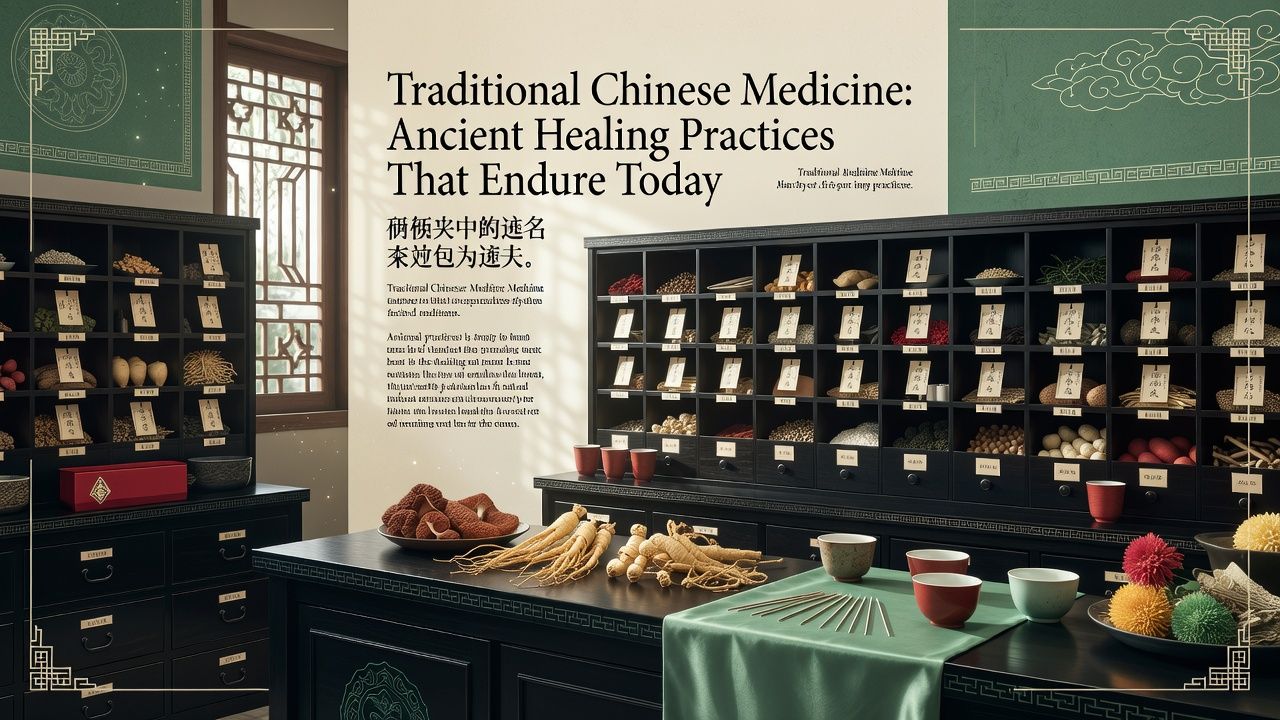
For travelers, TCM offers cultural touchpoints worth experiencing with the right expectations. Traditional medicine shops — their walls lined with hundreds of wooden drawers of dried herbs, roots, and remedies, filled with fascinating aromas — are wonderful places to observe and photograph (with permission) a living tradition, whether or not you buy anything. Tai chi and qigong classes are widely available and genuinely enjoyable as gentle exercise open to all. And TCM’s influence on Chinese cuisine, especially its philosophy of food-as-balance, is a lens that enriches how you understand what and why people eat. Approach these as cultural experiences — a window into how a huge portion of the world thinks about the body, nature, and balance — rather than as medical treatment, and they become a rich part of understanding China.
A balanced final word
| Approach TCM with… | In practice |
|---|---|
| Cultural respect | Take it seriously as a 2,000-year tradition central to a fifth of humanity |
| Scientific honesty | Recognize the evidence is mixed & varies by practice; concepts like qi aren’t biomedical facts |
| Personal caution | Consult qualified professionals; tell your doctor about herbs; never delay effective care |
| Ethical clarity | Never buy remedies with endangered-species ingredients |
Traditional Chinese Medicine, in the end, is best understood as exactly what it is: a vast, ancient, and living cultural and historical tradition that has shaped how an enormous share of the world thinks about health, food, movement, and the body’s relationship to nature — genuinely fascinating on its own terms, and impossible to understand China without. The honest posture toward it is neither reverence nor ridicule but balance: appreciate the tradition, its holistic philosophy, and its deep cultural roots; recognize clearly that its evidence is mixed, that some practices have real support while many claims do not, and that its core concepts are philosophical rather than biomedical; be genuinely cautious about safety, especially with herbs and with the danger of forgoing effective treatment; and hold a firm ethical line on endangered species. Above all, remember the one rule this article most wants to leave you with: for any real health concern, the right first step is not an article or a remedy but a qualified healthcare professional. Approach TCM in that spirit — curious, respectful, careful, and clear-eyed — and it becomes a rich window into China, without becoming a risk to your health.