Arts & Traditions
Painted faces, soaring falsetto, acrobatic battles, and costumes of impossible splendor — Chinese opera can bewilder a first-timer. A little decoding turns it into one of the world’s great spectacles.
A newcomer’s first encounter with Chinese opera is often equal parts dazzled and baffled. The stage blazes with color — performers in elaborate silk costumes and headdresses, faces masked in bold painted patterns; the singing soars into a high, stylized register unlike anything in Western music; the orchestra clangs and drives with gongs, cymbals, and piercing strings; and suddenly a “battle” erupts into breathtaking acrobatics and martial movement. To the uninitiated it can seem strange, even impenetrable. But Chinese opera — and especially its most famous form, Peking (Beijing) opera — is one of the world’s great total-theater art forms, combining music, singing, mime, dance, acrobatics, and stunning visual spectacle into a tradition centuries deep. And here is the encouraging secret: once you understand a few keys to its highly symbolic visual and performance language, the bewilderment falls away and the spectacle opens up. This guide provides those keys.
Peking opera, which crystallized into its classic form roughly two centuries ago and became China’s most celebrated theatrical tradition, is recognized on UNESCO’s intangible cultural heritage lists at ich.unesco.org — but it is only the most famous of hundreds of regional Chinese opera styles, each with its own dialect, music, and flavor. What unites them is a fundamentally symbolic approach: rather than realistic sets and naturalistic acting, Chinese opera works through a rich, codified language of conventions — where a color tells you a character’s nature, a gesture conjures an invisible object, and a few steps cross a thousand miles. Learn to read that language, even a little, and a performance transforms from an exotic wall of sound and color into a legible, thrilling story. Let’s decode the essentials: the role types, the painted faces, the symbolic staging, and how to enjoy your first show.
The four role types: reading the cast
The first key is that every performer belongs to one of four main role categories, each with its own style of singing, movement, costume, and makeup — and recognizing them instantly orients you in any performance. Performers typically train intensively for years in a single role type, mastering its particular skills, so the categories are as much specialized disciplines as character types:
| Role type | Who they are | How to spot them |
|---|---|---|
| Sheng 生 | The main male roles — scholars, officials, warriors, young men | Dignified; relatively natural makeup; subtypes for old men, young men & martial heroes |
| Dan 旦 | The female roles — from virtuous ladies to warrior women and lively maids | Graceful movement, high delicate singing, flowing “water sleeves”; historically played by men |
| Jing 净 | The “painted face” roles — bold, powerful men: generals, heroes, gods, villains | The spectacular full-face painted masks; big, forceful voices & presence |
| Chou 丑 | The clown — comic roles, tricksters, servants, comic officials | A distinctive small white patch around eyes & nose; agile, funny, quick-witted |
One historically fascinating detail: the celebrated dan (female) roles were traditionally performed by male actors, and some of the greatest and most revered stars in Peking opera’s history were men who specialized in playing women, elevating the art to extraordinary refinement — a convention that shaped the whole tradition. Knowing the four types pays off immediately at a performance: the moment a spectacularly painted-face jing strides on with a booming voice, or a graceful dan enters with flowing sleeves and soaring song, or the white-nosed chou tumbles in for comic relief, you already know something essential about who they are and what to expect — the cast becomes readable at a glance.
The painted faces: a code you can read
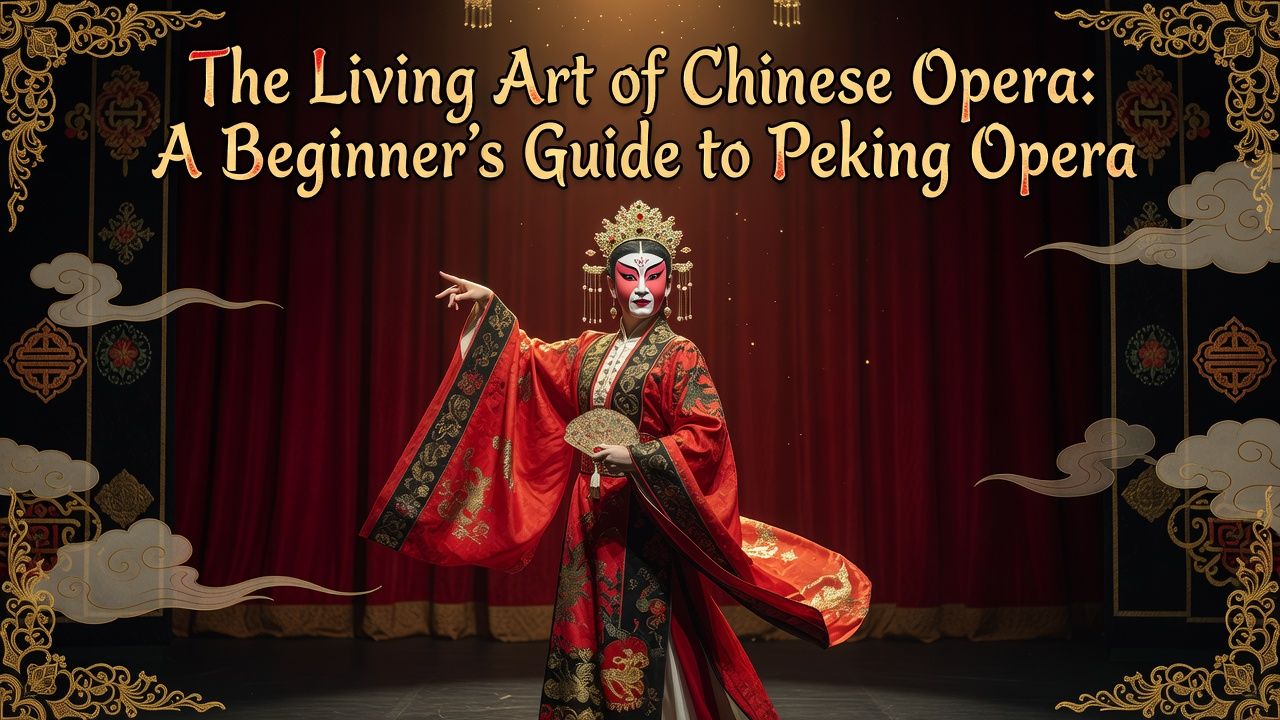
The most iconic and dazzling element of Peking opera is the painted face (lianpu) — the bold, colorful full-face makeup worn by the jing roles — and here lies one of the tradition’s most delightful secrets: the colors and patterns are a code that tells the audience the character’s personality and moral nature at a glance. This is symbolic shorthand refined over generations, and while there are nuances and exceptions, the broad conventions are wonderfully legible once learned:
| Face color | Typically signals |
|---|---|
| Red | Loyalty, courage, righteousness — a heroic, honorable character |
| Black | Boldness, integrity, impartiality — a fierce but upright figure |
| White | Craftiness, treachery, suspicion — often the cunning villain |
| Blue / green | Wildness, fierceness, stubbornness — brave but unruly characters |
| Yellow | Ferocity or ambition — sometimes cruelty |
| Gold / silver | Gods, spirits, and supernatural beings |
This means that an informed audience member can look at a character’s face as they enter and immediately grasp their essential nature — a red face signals a hero to trust, a white face warns of a schemer — before they’ve sung a note. The patterns are also specific: many famous historical and legendary characters have their own distinctive, instantly recognizable face designs, so devoted fans identify exactly who a character is from the makeup alone. The painted faces are simultaneously stunning visual art — the designs are genuinely beautiful and have become a symbol of Chinese culture worldwide — and a functional storytelling device. Learning even this simple color code transforms the experience: what looked like exotic decoration reveals itself as a language, and you find yourself “reading” the characters as they appear, exactly as the tradition intends.
The symbolic stage: how less becomes more
The third key is understanding that Chinese opera is profoundly non-realistic and symbolic in its staging — and once you grasp this, its apparent “simplicity” of sets reveals itself as sophistication. The traditional stage is nearly bare, with minimal scenery, because the performers create the world through stylized, codified movement, and props stand in symbolically for far more than themselves. A whip in hand means the character is riding a horse; walking in a circle around the stage represents a long journey over great distances; an oar mimes a boat; lifting a foot high signals stepping over a threshold; opening imaginary doors, climbing invisible stairs, and sewing nonexistent cloth are all conveyed through precise, learned gestures. The audience, fluent in these conventions, sees the horse, the journey, the boat, the room — the imagination supplies what the stage deliberately omits.
Even objects and colors on the costumes carry meaning: elaborate costumes signal rank and role, and details like the flags a general wears on his back or the pheasant feathers on a headdress convey specific information to those who can read them. The famous “water sleeves” — long white silk extensions on the cuffs of some costumes — are flicked, waved, and folded in expressive movements that convey emotion. This whole symbolic system means Chinese opera asks something of its audience that realistic theater does not: active imaginative participation, meeting the performance halfway. That’s part of why it can feel opaque to newcomers — you haven’t yet learned the code — and part of why it becomes so rewarding once you have, because you’re not passively watching a spectacle but actively reading a rich visual language. The bare stage isn’t a limitation; it’s an invitation.
Music, movement, and the shape of a show
The soundworld of Peking opera is as distinctive as its look, and knowing what to expect helps enormously. The singing is highly stylized — often in a high, piercing register that can surprise Western ears — and follows set melodic patterns rather than through-composed songs; it takes acclimatization, and it’s fine to simply let it wash over you at first. The orchestra divides into two wings: melodic instruments (led by high-pitched bowed and plucked strings and flutes) that accompany the singing and lyrical scenes, and a percussion section (gongs, cymbals, drums, and the sharp clappers that keep time) that drives the action, punctuates movement, and builds the electric energy of the battle scenes. That percussion is the heartbeat of the acrobatic sequences — the martial wu scenes, full of stunning tumbling, weapon-twirling, and combat choreography that are pure athletic spectacle and often the highlight for first-time viewers, needing no translation at all.
The repertoire draws on a treasury of classic stories — historical episodes, legends, romances, and tales from beloved novels like Journey to the West (with its irrepressible Monkey King, a perennial audience favorite) and Romance of the Three Kingdoms — so the plots would have been familiar to traditional audiences, who came as much for a favorite star’s rendition of a beloved scene as for the story. This is worth knowing as a newcomer: you’re not expected to follow every plot detail, and many performances presented for visitors are curated selections of the most spectacular and accessible scenes — the acrobatic battles, the comic turns, the visually stunning set pieces — rather than long, dialogue-heavy full operas. Modern venues also frequently provide subtitle screens with translations, removing the language barrier. The ideal newcomer’s introduction, in fact, is exactly such a highlights performance, which front-loads the spectacle and keeps the pace lively.
Enjoying your first performance
For a traveler in China, seeing a live performance is far better than any description, and a few tips make a first show a delight rather than a puzzle. Choose an accessible introduction: many theaters in Beijing and other cities offer performances aimed at visitors — often shorter, with the most spectacular and comprehensible scenes, English subtitles, and sometimes a brief explanation of the art form — which are ideal for beginners, while some traditional teahouse-style venues let you sip tea and snack as you watch, in an atmosphere closer to how opera was historically enjoyed. Arrive knowing the keys from this guide — the four roles, the face-color code, the symbolic gestures — and you’ll find yourself reading the performance rather than merely gaping at it. And come for the right pleasures: let the spectacular visuals, the athletic brilliance of the acrobatics, the gorgeous costumes, and the sheer otherness of the art form carry you, rather than straining to follow every sung line.
| First-timer tip | Why |
|---|---|
| Pick a visitor-friendly highlights show | Best scenes, shorter, often subtitled — spectacle-forward |
| Learn the 4 roles & face colors first | Turns confusion into readable storytelling |
| Focus on the acrobatics & visuals | These need no translation and are pure thrill |
| Don’t stress about following every word | Even the singing style takes acclimatization; enjoy the whole |
| Try a teahouse-style venue if available | Tea, snacks & a traditional, relaxed atmosphere |
Chinese opera, like the calligraphy and other traditional arts it shares a culture with, rewards the small effort of learning its language many times over. It is a living tradition — still performed, still trained for over grueling years, still beloved, even as it works to attract younger audiences in a modern age — and to see it live is to witness a total art form of extraordinary discipline and beauty, one that fuses music, drama, dance, acrobatics, and visual splendor into something Western theater has no exact equivalent for. Go in with the keys — the four roles, the painted-face code, the symbolic stage where a whip is a horse and a circle is a journey — and the bewilderment that greets so many first-timers gives way to genuine delight. What looked like an impenetrable wall of color and sound reveals itself as exactly what it is: one of the world’s great performing arts, waiting only for you to learn to read it.