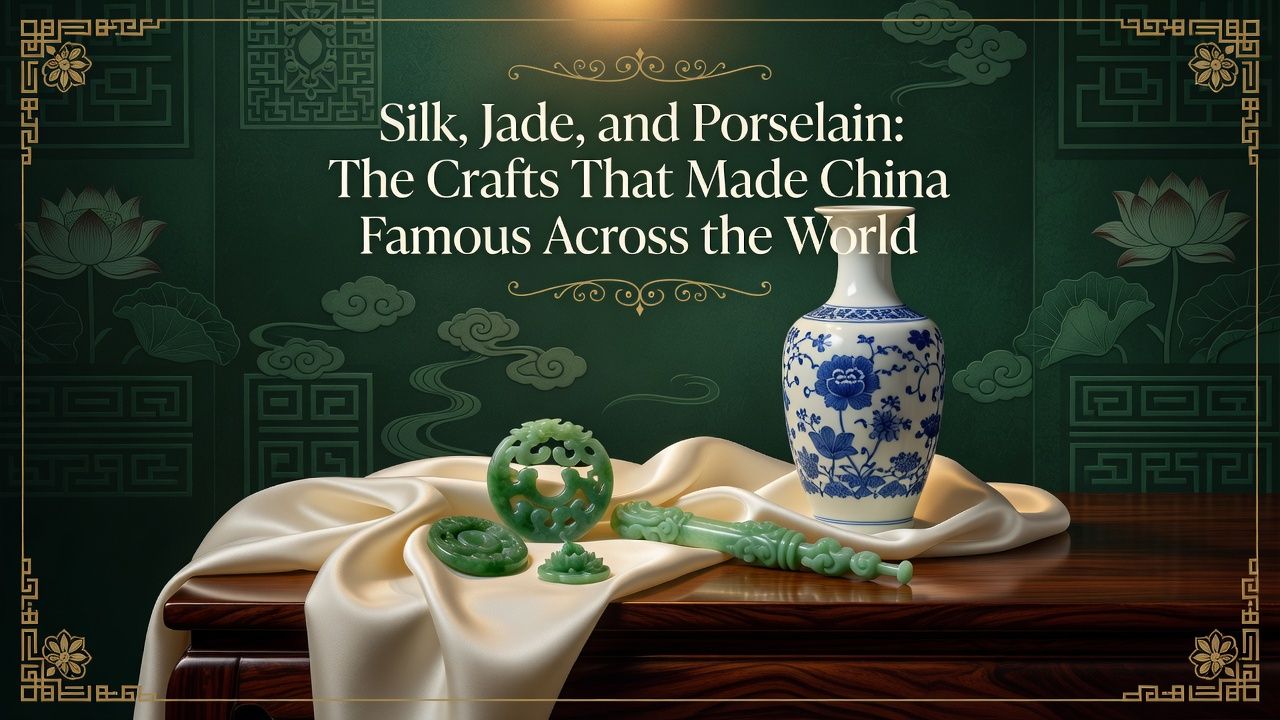
Arts & Traditions
Three materials so bound to China that one gave the country its very name in English. The story of silk, jade, and porcelain is the story of how Chinese craft conquered the world — and how to appreciate it today.
Some materials are so completely bound to a single civilization that they become its signature, and China gave the world three: silk, jade, and porcelain. Each represents a pinnacle of craftsmanship developed and perfected in China over thousands of years; each became a treasure coveted across the globe; and each shaped history and trade in profound ways — silk gave its name to the great Silk Road that linked China to the West, and porcelain became so synonymous with the country that in English we still call fine porcelain, simply, “china.” Together these three crafts tell the story of how Chinese artistry and technical mastery conquered the world, defining the country’s image abroad for two millennia and driving trade routes, diplomacy, and imperial fortunes. This guide explores all three — their history and significance, what makes them special, the cultural meanings they carry, and how travelers and admirers can appreciate and shop for them wisely today.
What unites silk, jade, and porcelain beyond their fame is that each demonstrates a distinctively Chinese pattern: the transformation of a natural material into an object of supreme refinement through patient, secret-guarded, endlessly perfected technique. For centuries China held the exclusive knowledge of how to make silk and porcelain, guarding these secrets so closely that the technologies were worth more than gold and their eventual leakage to the wider world changed economies and empires. Jade, meanwhile, was elevated from mere stone to the most spiritually and culturally revered material in Chinese civilization. Several of these crafts and their techniques are recognized on UNESCO’s cultural heritage lists at ich.unesco.org, and their finest historical examples fill the world’s great museums, from Beijing’s Palace Museum to the collections of the Metropolitan Museum of Art. Let’s meet the three materials that made China famous.
Silk: the thread that wove the world together
Silk is China’s oldest world-famous craft and perhaps its most historically consequential. The Chinese discovered how to cultivate silkworms and unwind their cocoons into thread — a process called sericulture — thousands of years ago, and for many centuries China held a complete global monopoly on this luminous, strong, shimmering fabric, guarding the secret of its production so fiercely that revealing it could be a capital offense. Silk became China’s supreme luxury export, so prized in the ancient world — by Rome and everywhere in between — that the demand for it opened the legendary Silk Road, the network of trade routes carrying silk (and much else) westward across Asia and transforming civilizations along the way. The fabric wasn’t just a commodity; it was currency, diplomacy, and status, and the trade in it wove distant cultures together, making silk one of the most important materials in all of human history.
Beyond its economic role, silk is simply a magnificent craft. Chinese silk production grew extraordinarily sophisticated, encompassing the raising of silkworms, the delicate reeling of thread, and above all masterful weaving, dyeing, and embroidery — producing everything from shimmering plain silks to intricate brocades woven with elaborate patterns and exquisite embroidered silk artworks of astonishing detail and beauty. Regional embroidery traditions (such as the famous Suzhou embroidery, renowned for its fineness and even double-sided works) reached the level of high art. For travelers today, silk offers rich experiences: silk museums and workshops (Suzhou and Hangzhou are famous silk centers) let you see the whole process from cocoon to cloth, and silk remains a wonderful thing to buy — scarves, clothing, bedding, embroidered art — though quality and authenticity vary, so buying from reputable specialist shops and learning to distinguish genuine silk from imitations is wise, as it’s a commonly counterfeited product.
Jade: the stone of heaven and virtue
If silk conquered the world, jade conquered the Chinese soul. No material has been more revered in Chinese culture than jade, prized for thousands of years above gold and silver and imbued with profound spiritual, moral, and cultural meaning. To the Chinese, jade was far more than a beautiful stone: it symbolized purity, virtue, moral integrity, and even immortality, and Confucius himself was said to have compared the qualities of the noble person (the junzi) to the qualities of jade — its smoothness to kindness, its firmness to intelligence, its purity to virtue. Jade was believed to possess protective and auspicious powers, was buried with the dead (ancient royalty were even entombed in astonishing suits of jade plates sewn with gold), was carved into ritual objects and imperial seals, and was worn as protective amulets. This deep cultural reverence, not mere prettiness, is what makes jade special in China — it is the material most bound up with the culture’s highest values.
The craft of jade carving matches the stone’s status. Jade is extraordinarily hard and cannot be cut like softer stones — it must be painstakingly ground and abraded, so that a fine jade carving can represent an immense investment of skilled labor, and master jade carvers are highly esteemed. The results range from delicate pendants and bangles to intricate ornamental carvings, vessels, and sculptures of remarkable artistry. Two points help the traveler appreciate and shop for jade wisely. First, “jade” properly refers to two minerals — nephrite (the classic, historically Chinese jade) and jadeite (a harder, often more vividly colored stone, including the prized emerald-green “imperial jade,” much of it from Myanmar) — and colors range from white and pale green to deep green, lavender, and more. Second, and importantly, the jade market is notoriously full of fakes, dyed and treated stones, and misrepresented material, and valuing jade is genuinely difficult even for experts — so casual buyers should treat inexpensive pieces as attractive souvenirs rather than investments, be very cautious about expensive purchases, buy only from reputable sources, and, for any significant purchase, seek expert authentication. Admiring museum jade — where the finest historical carvings are displayed — is a pleasure available to everyone with no risk at all.
| Craft | Cultural meaning | World-historic role |
|---|---|---|
| Silk 丝 | Luxury, refinement, status; a supreme textile art | Opened the Silk Road; China’s great export monopoly for centuries |
| Jade 玉 | Virtue, purity, immortality; prized above gold — the culture’s most revered stone | Ritual objects, imperial seals, burial treasures across millennia |
| Porcelain 瓷 | Technical & artistic perfection; refinement in daily & imperial life | So identified with China it named the material “china”; a vast global trade |
Porcelain: the craft that named a country
The third great craft may be the most astonishing technical achievement of the three. Porcelain — the fine, hard, white, translucent, resonant ceramic — was invented and perfected in China, the culmination of a ceramic tradition thousands of years deep, and for centuries China alone knew how to make it. This gave China a monopoly on the world’s most coveted ceramic, and Chinese porcelain became a global sensation and a colossal export industry: the exquisite blue-and-white wares, celadons, and countless other types were shipped across Asia, the Islamic world, and eventually Europe, where they were treasured beyond measure and inspired centuries of desperate, expensive, largely failed attempts to reverse-engineer the secret. So thoroughly did fine porcelain become identified with its origin that the English word for it became, simply, “china” — a linguistic monument to a craft that defined a civilization in the world’s imagination. Few objects have carried a country’s name and prestige so far.
The artistry of Chinese porcelain is a vast world in itself. Different dynasties and kilns produced their own celebrated styles — the serene celadons, the classic blue-and-white painted wares that became globally iconic, delicate famille-rose enamels, monochrome glazes of jewel-like perfection, and much more — and the imperial kilns produced pieces of breathtaking refinement for the court. The historic porcelain capital, Jingdezhen, has been called the “porcelain capital” for over a thousand years and remains a living center of the craft, where visitors can see the tradition continuing and buy directly from workshops. For travelers, porcelain is one of China’s most rewarding crafts to explore: museums display world-treasure historical pieces, Jingdezhen and other centers offer workshops and shopping, and porcelain makes a beautiful (and, in modest pieces, affordable and practical) souvenir — from a single hand-painted tea cup to a fine vase — with the same sensible cautions about quality and, for antiques, authenticity and export rules.
Appreciating and buying wisely
For anyone drawn to these crafts, a few shared principles turn appreciation into informed enjoyment and protect against the pitfalls. First and most rewarding: visit the museums. China’s great museums — the National Museum and Palace Museum in Beijing, the superb Shanghai Museum, and provincial museums nationwide — display the finest historical silk, jade, and porcelain, offering an experience of the crafts at their absolute peak that requires no expertise and carries no risk. Seeing masterworks trains your eye and deepens appreciation of anything you later buy. Second, seek out the craft centers — the silk workshops of Suzhou and Hangzhou, the porcelain kilns of Jingdezhen — where you can watch the traditions live and buy closer to the source. Third, when buying, match your caution to the price: inexpensive pieces are lovely, low-risk souvenirs to enjoy for their beauty, but the higher the price, the more the cautions matter.
| Buying wisely | Key advice |
|---|---|
| Silk | Commonly faked; buy from reputable specialists; learn to tell real silk from synthetics |
| Jade | Market full of fakes & treated stones; hard to value; enjoy cheap pieces as souvenirs, authenticate anything costly |
| Porcelain | Modern pieces make great affordable souvenirs; be cautious with “antiques” & mind export rules |
| Antiques (all) | Genuine antiques face export restrictions & heavy faking; approach with real expertise or not at all |
| Golden rule | Buy what you love for its beauty; treat big-ticket buys as investments only with expert guidance |
A special caution applies to antiques across all three crafts: genuine Chinese antiques are subject to export restrictions and are heavily faked, so unless you have real expertise, it’s safest to buy new, well-made contemporary craft pieces — which are beautiful, authentic in their own right, and free of legal and authenticity headaches — rather than chasing “ancient” treasures in tourist markets. The soundest philosophy for all three materials is simple: buy what genuinely delights you, at a price you’re happy to pay for the pleasure of the object itself, from a reputable source — and leave serious collecting and investment to those with genuine expertise.
Silk, jade, and porcelain, taken together, tell one of the great stories of human craftsmanship — how a civilization took a worm’s cocoon, a hard stone, and refined clay, and through millennia of patient, secret, endlessly perfected technique transformed them into objects so beautiful the whole world craved them, so identified with their maker that they carried China’s name and image to the ends of the earth. They opened trade routes, shaped economies, defined luxury, and embodied the culture’s deepest values — virtue in jade, refinement in silk and porcelain, mastery in all three. To appreciate them is to understand something essential about China: a civilization that pursued perfection in the making of things with a patience and artistry few cultures have matched. See them at their peak in the great museums, watch the living traditions in the craft cities, bring home a piece you love for its own beauty — and carry with you a thread of the artistry that, quite literally, made China famous across the world.