Most of China’s old cities were torn down and rebuilt in concrete decades ago. Pingyao, a county seat in the middle of Shanxi province, missed that fate almost by accident, and today its 14th-century street plan, its Ming-era brick wall, and the courtyard bank that started Chinese banking all survive within a single 6-kilometer loop of ramparts.
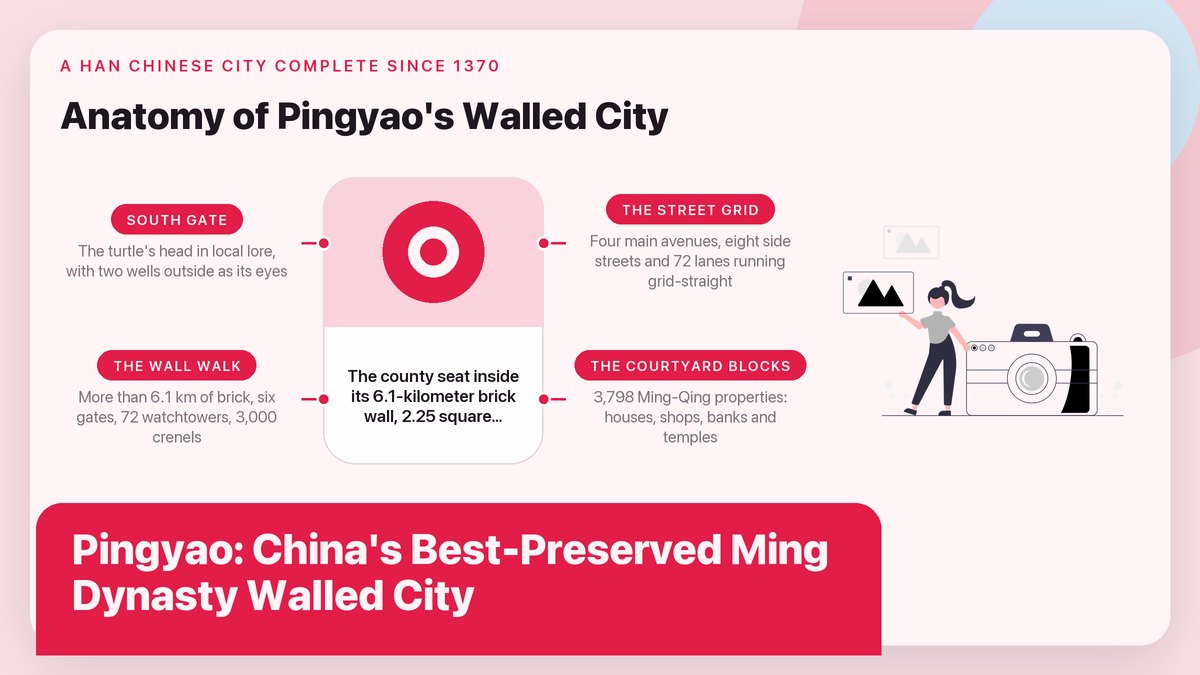
The first thing you see from the train is a brick wall where other Chinese cities show you a skyline. As the high-speed service slows for Pingyaogucheng station, some 35 kilometers (about 22 miles) short of the old town, the flat farmland of central Shanxi starts to gather roofs, grey tile laid in neat courtyard squares. Then the wall itself swings into view. The loop runs more than 6.1 kilometers (3.8 miles) and stands roughly 12 meters (39 feet) high in its rebuilt sections. Yet it encloses only 2.25 square kilometers of streets, and inside that small area, according to figures China Daily published in 2024, sit 199 old streets and alleys, 3,798 residential and commercial properties dating from the Ming and Qing dynasties, 143 registered historical sites, and 1,075 immovable cultural relics. That’s a dense archive of surviving history for a place many travelers outside China have never heard of, and it’s the reason the Ancient City of Pingyao made the UNESCO World Heritage List in December 1997.
UNESCO inscribed far more than the walls. The listing covers the whole urban fabric plus two Buddhist temples in the suburbs, and the evaluation report described Pingyao as an exceptionally well-preserved example of a traditional Han Chinese city founded in the 14th century. The report saved its strongest language for the banking buildings, since Pingyao ran the finances of all China in the 19th and early 20th centuries. Nearly every first-time visitor is surprised by that pedigree, because a town of courtyard houses and electric carts effectively invented Chinese paper remittance two centuries before Western bank branches reached the interior. You can still visit the original bank, sleep in a 300-year-old merchant’s house, and walk the wall at sunset within one weekend, which is why Pingyao anchors almost every Shanxi itinerary.
In this article
A County Seat the Modern Age Skipped
From Qin-dynasty county seat to 1997 World Heritage listing
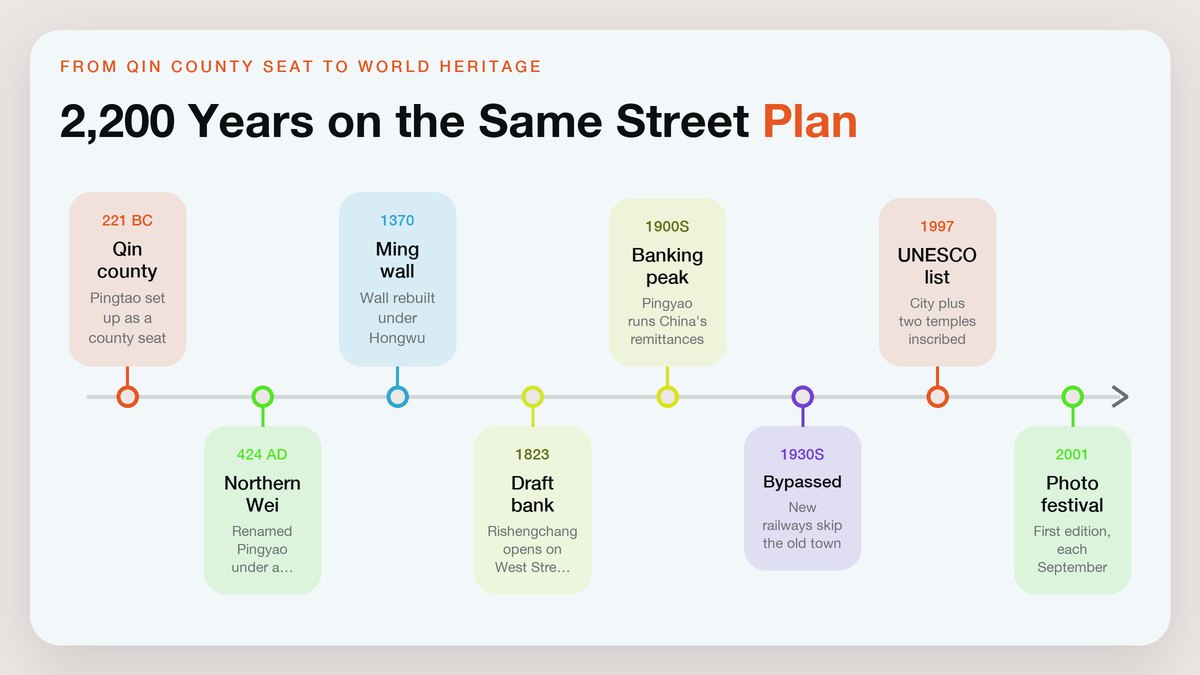
The settlement served as a county seat from the Qin dynasty, more than two thousand years ago, so its administrative continuity runs deeper than the wall does. It carried the name Pingtao until the Northern Wei period, when a naming taboo attached to an emperor’s personal name forced the switch to Pingyao, a name usually translated as “peaceful and remote.” Neither half proved accurate, at least commercially. By the early Ming dynasty the town sat on the trade routes that Shanxi merchants, later known as the Jinshang, used to move tea and silk between China’s interior and the Mongolian and Russian markets to the north. When the Ming founder Zhu Yuanzhang ordered the nation’s city walls rebuilt after 1368, Pingyao refaced its rammed-earth defenses in brick. The year 1370, the third of the Hongwu reign, is the date every local guide gives for the wall you walk today.
The wall served as a working defense for centuries, then as an ornament, and then as a fluke. After the Qing dynasty fell in 1912, Pingyao’s economy collapsed along with its banking industry, and the modern railway lines pushed through Shanxi in the 1930s bypassed the old town rather than threading through it. Cities that got the railway got factories, concrete apartment blocks, and demolition crews; Pingyao got none of those. By the 1980s heritage officials had realized that an almost complete Ming-Qing county city had survived inside its brick shell, and the UNESCO listing in December 1997, shared with the Shuanglin and Zhenguo temples outside the walls, turned the town from a backwater into a destination almost overnight. It’s worth pausing on what survived, because it isn’t one palace or one temple. An entire working county city made it through: the magistrate’s courtroom, the prison, the banks, the guildhalls, the temples, and several thousand family courtyards.
The Turtle, the Grid, and the Wall Walk
Six gates, 72 watchtowers, 3,000 crenels, and one deliberate turtle
Local tradition says the walled city is shaped like a turtle, and the metaphor is mapped onto the gates in detail. The south gate, set at the head of the main street, is the turtle’s head, with two wells outside it standing in for eyes. The north gate is the tail, and the two gates on each side form the four legs. Whether or not the Ming masons intended the animal, the layout underneath is strictly utilitarian: four main avenues run the cardinal directions, crossed by eight side streets and roughly 72 narrow lanes. The grid made tax collection and defense simple for a county government, and the number 72 recurs constantly in Pingyao’s official statistics. Local guides will tell you it honors the 72 disciples of Confucius, though that tidy symbolism may be a later gloss on an engineer’s arithmetic.
You can walk the full circuit of the wall, and most visitors do, because the loop takes between 90 minutes and two hours on foot and less if you rent one of the tandem bicycles that rattle along the ramparts. China Daily’s architectural survey of the site counts six gates, four corner turrets, 72 watchtowers, and 3,000 crenels along the brick circuit. Go late in the afternoon, when the tour groups have thinned and the light lies flat across the grey rooftops, and you’ll share long stretches of the parapet with local photographers rather than crowds. Down below, the old South Avenue, now called Ming-Qing Street, runs some 750 meters from the south gate as the commercial spine. Its lantern shops, vinegar sellers, knife-cut noodle counters, and courtyard guesthouses fill the former merchant compounds that made this street the richest address in 19th-century China.
The Bank That Moved Money Without Moving Silver
Rishengchang, founded 1823 on West Street: China’s first draft bank
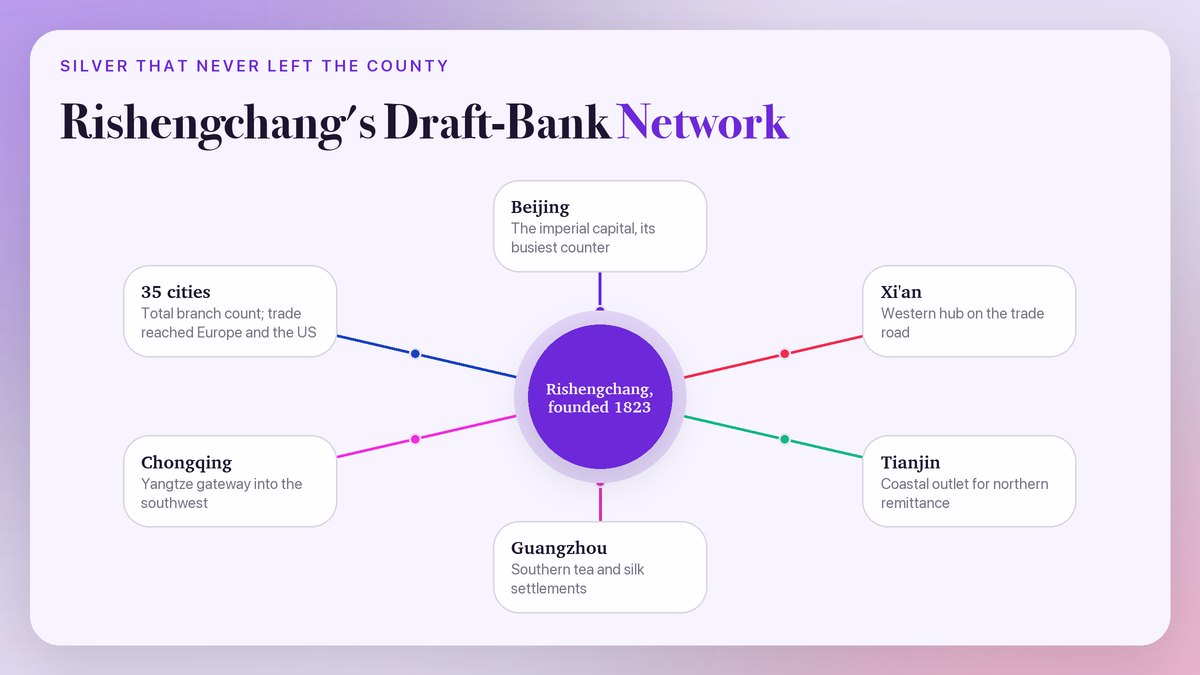
In 1823, in the third year of the Daoguang reign, a Pingyao merchant named Li Daquan turned his dye business on West Street into something new. The shop became a piaohao, a draft bank called Rishengchang, the name usually rendered as “sunrise prosperity.” The manager who made the idea work, Lei Lutai, understood the problem his merchant neighbors faced every trading season. Silver moved slowly and dangerously across China in carts guarded by armed escort companies called biaoju, vulnerable to bandits, floods, and the sheer weight of the metal. Rishengchang’s solution was paper. A merchant deposited silver in Pingyao, received a draft called a huipiao, and cashed it at a Rishengchang counter in Beijing or Xi’an days later, minus a fee. The silver never really left the county; only the paper traveled, protected by watermarked draft stock, duplicate hand-written ledgers, and codes that changed on a schedule. Forgery, in other words, was a capital-risk business.
The model spread fast. By the middle of the 19th century the Shanxi merchant houses had turned Pingyao, along with neighboring Qi County and Taigu, into the clearinghouse for the empire’s remittances. By some counts more than twenty piaohao had their headquarters inside Pingyao’s walls alone, and Rishengchang itself grew to 35 branches in cities across China, with business reaching into Europe, the United States, and Southeast Asia. China Daily’s profile of the bank notes it operated for over a hundred years before closing in the early 20th century, when coastal treaty ports, foreign banks, and steamship lines pulled trade away from the overland routes the Shanxi merchants had ridden for centuries. The British missionary and writer Joseph Edkins, visiting Pingyao’s piaohao in the late 19th century, wrote that he was looking at the inception of China’s banking system, and historians of Chinese finance still treat him as roughly right.
| Biaoju (escort company) | Piaohao (draft bank) | |
|---|---|---|
| What moved | Actual silver carts on the road | Paper drafts between branch counters |
| Protection | Armed guards, martial artists on contract | Watermarks, duplicate ledgers, rotating codes |
| Peak era | Ming through mid-Qing | 1823 to early 1900s |
| Why it lost | Railways and banks made armed convoys obsolete | Foreign banks and coastal steamship trade drew business away |
The bank’s buildings survived because they were built like fortresses and lived in afterwards as shops, warehouses, and housing through the lean decades. Today the compound, a three-courtyard layout of some 1,386 square meters holding 21 rooms, operates as a museum with more than 20 exhibition halls. You can still see the high counters where clerks sat, the heavy vault, and the carved screen walls that kept prying eyes off the counting tables. It’s a small museum with no interactive displays worth the name, but that thinness is part of the point. The building itself, rank on rank of grey-brick rooms around three paved courts, explains the business better than any label does.
Courtyards, the Yamen, and Two Temples Outside the Gates
The county government compound alone covers some 26,000 square meters
One Pingyao courtyard explains most of the old town, because nearly everything inside the walls, the bank included, follows the same siheyuan template. Rooms stand on four sides of a paved rectangle, and rank is read from the layout. The north main hall, warmed by the winter sun and buffered from the northern winds, went to the family head. The east wing housed the elder son, the west wing took younger children or guests, and the south rooms, closest to the gate and its traffic, served as study, storage, and servants’ quarters. Visitors entered through a gatehouse set off-axis and screened by a spirit wall, so the household wasn’t exposed to the street or, in folk belief, to wandering spirits, which travel in straight lines.
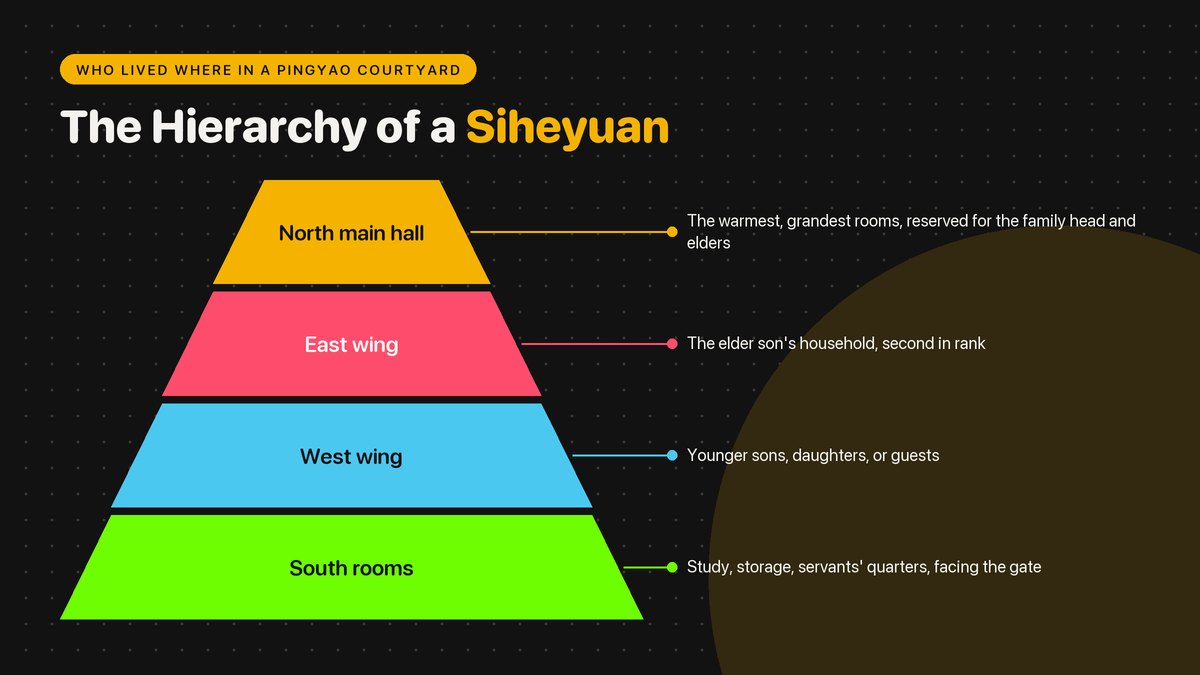
Scale that template up by a few dozen rooms and you get the Pingyao County Government Office, the yamen, whose compounds cover more than 26,000 square meters. That makes it the largest surviving county government complex in China. For around six centuries it housed the magistrate, his clerks, the courtrooms where civil cases were heard, the tax office, a prison wing, and a garden for contemplation, all behind the ceremonial gate on Yamen Street. Walk through in an hour and you’ll see judgment halls arranged with braziers and intimidation in mind, a small shrine to the city god across the lane, and the Confucian temple’s old cypresses, one of which is said to be close to 800 years old. The complex survives as a working model of imperial county administration, which is why school groups from across Shanxi file through it by the busload on weekday mornings.
The two suburban temples that share the World Heritage listing make easy half-day trips, and both reward the detour. Shuanglin Temple, about 6 kilometers (roughly 4 miles) southwest of the south gate, is a sculpture gallery frozen in place. More than 2,000 colored clay figures from the Ming and Qing periods fill its halls, including the Four Heavenly Kings whose glaring eyes were inset with dark glass to make the guardians unnervingly lifelike, and Chinese art historians have long called the temple a treasure house of colored sculpture. The Zhenguo Temple, a short drive northeast, is quieter and, for architecture buffs, the more significant of the two. Its main hall, built in 963 during the Five Dynasties period, is one of only three surviving wooden structures in China from that era, and its interior murals are described as the only ones of their period still in place. In August 2024 both temples gained a second life as settings in the video game Black Myth: Wukong. In the twenty days after the game’s release on August 20, according to China Daily’s reporting on the surge, Shuanglin recorded more than 36,000 visits, up over 500 percent from the same stretch a year earlier. Go on a weekday morning if you want the halls to yourself.
Beef, Vinegar, and Two Festivals
The photography festival has drawn some 50,000 photographers since 2001
Shanxi’s food reputation rests on two pillars, and Pingyao serves both at their source. The first is beef. Pingyao beef is a cured, simmered product with a documented history stretching back at least to the late Qing, pressed into dense rose-colored slabs and sold by weight from shops that keep the same addresses their predecessors held a century ago. The second pillar is vinegar. Shanxi mature vinegar, laochencu, is aged in clay crocks for years until it turns dark and almost syrupy, sharp enough to wake up a plate of knife-cut noodles and mellow enough to sip, which elderly locals genuinely do, a tablespoon at a time. Between those poles sit the everyday dishes: youmian kaolaolao, oat dough rolled into small tubes and steamed in wicker rings, and wantuo, a firm buckwheat jelly shaved into bowls and dressed with chili and, of course, vinegar. None of it carries big-city prices. A filling meal along the Ming-Qing Street costs less than a taxi across Shanghai, and the best versions still come from open kitchens on that same street.
Since 2001 Pingyao has also been a serious photography town. The Pingyao International Photography Festival, first held in September of that year, has drawn roughly 50,000 photographers from more than 100 countries over its run and put about 370,000 works on display, with cumulative visitor numbers past five million according to county officials quoted by China Daily. The festival takes over factory yards and temple courtyards every September, and even in off years the town wears its camera culture openly, with exhibition prints hanging in teahouses and guesthouse walls doubling as galleries. In 2017 the county added a film festival. The director Jia Zhangke, who grew up in neighboring Fenyang and shot parts of his 2000 film Platform in the region, founded the Pingyao International Film Festival. He told China Daily he chose Pingyao because it’s a city where traditions are interwoven with people’s daily life. The festival now ranks as the only international film festival hosted by a Chinese county seat, and its 2024 edition screened 52 films over seven days in late September. When online booking opened for that edition, the platform recorded 24 million visits in its first hour for screenings capped at around 5,000 seats.
Planning a Visit
Pingyao sits about 100 kilometers (62 miles) south of Taiyuan, Shanxi’s capital
Reaching Pingyao takes less effort than the town’s remote name suggests. The nearest major hub is Taiyuan, the provincial capital, about 100 kilometers (62 miles) north, and high-speed trains cover the run in roughly 30 to 40 minutes. They arrive at Pingyaogucheng station on the Datong-to-Xi’an line, while conventional trains use the older Pingyao station near the modern center. From Beijing, plan on about four hours door to door with a change in Taiyuan, and many travelers pair Pingyao with Xi’an, three to four hours farther southwest on the same corridor. English signage is patchy outside the main sights, since the old town remains a working county seat rather than a theme park, though guesthouse staff are practiced at arranging train tickets, local drivers, even English-speaking guides.
Sleep inside the walls if you can. Dozens of siheyuan compounds have been converted into guesthouses, from simple family-run courtyards with heated kang platforms to restored merchant houses with carved gate towers, and staying overnight is what turns Pingyao from a day trip into an experience. Once the tour buses leave and the lantern light comes on, the town offers the closest thing in modern China to a Ming-dynasty evening. Cars are banned from the old streets, so you walk or flag one of the electric carts that shuttle between gates. Two easy day trips round out a stay. The Qiao Family Compound, about 30 kilometers (19 miles) north, is the grand multi-courtyard mansion Zhang Yimou used as the setting for his 1991 film Raise the Red Lantern. The Wang Family Compound, slightly farther out, is a fortified hillside cluster of 231 courtyards built by a single clan over several generations.
If Pingyao’s merchant-bank story interests you, our guides to the Silk Road and China’s ancient trade routes and to China’s UNESCO World Heritage sites pick up where this one leaves off. Facts and figures here were checked against UNESCO’s evaluation, China Daily’s reporting, and museum records in November 2026; festival dates and ticket prices shift year to year, so confirm before you book.