In March 1974, farmers digging a well outside Xi’an hit something hard three meters down: a fired-clay head, staring up at them. Fifty years later, the buried army it belonged to is still being counted, measured, and pieced back together.
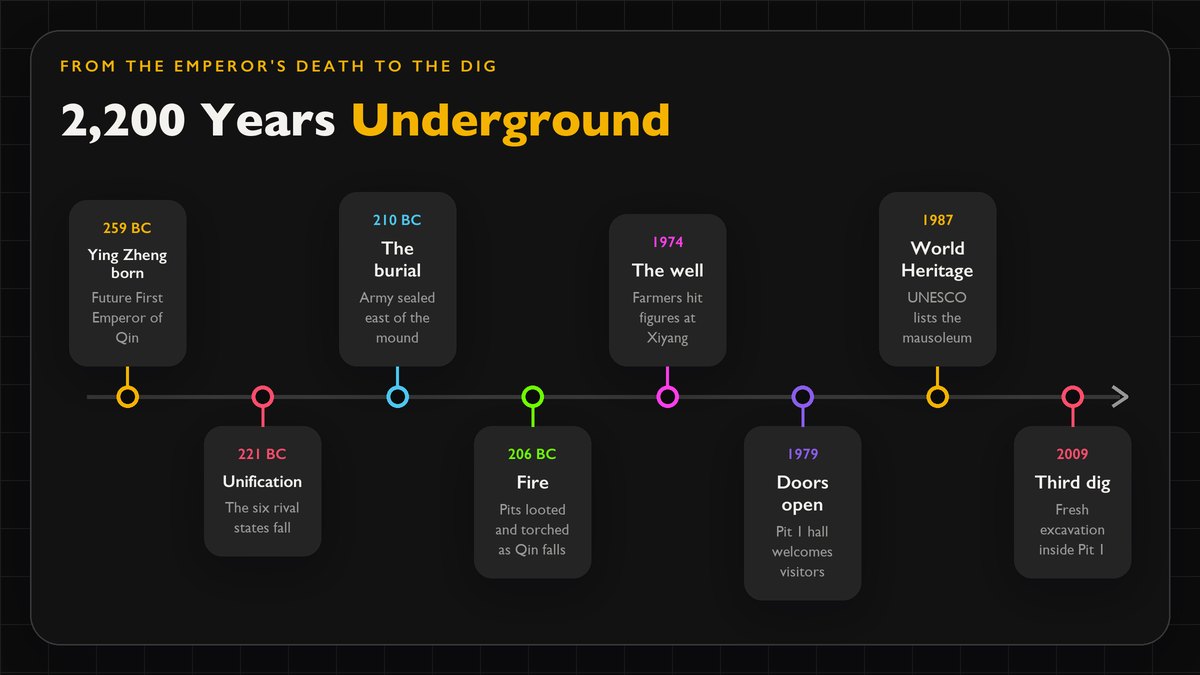
In the spring of 1974 the farmers of Xiyang village, in Lintong district about 35 kilometers (22 miles) east of Xi’an, were dealing with a mundane problem. The rains had failed, so the commune agreed to sink a new well, and the digging that March turned up fist-sized fragments of terracotta instead of water. Then a head came up over the rim of the pit, complete with painted features and a soldier’s topknot. The men reportedly carted the pieces to the local cultural office, where an official named Zhao Kangmin recognized fired clay of unusual quality and began collecting what the well kept giving. That slow, confused beginning is worth remembering, because the find it started, the Terracotta Army, would become one of the largest and most visited archaeological sites on earth.
What the farmers had stumbled into wasn’t a tomb in the ordinary sense. It behaved less like a tomb and more like a garrison under sealed orders. Covered timber pits, each the size of an aircraft hangar, held life-size clay soldiers standing in battle formation, four abreast, facing east toward the lands their emperor had conquered. When a formal archaeological team began work on Pit 1 on July 15, 1974, the outlines of something extraordinary were already clear. Chinese sources would later call it the most significant archaeological discovery of the twentieth century, and more than fifty years on the count still isn’t finished. The reason is a problem the excavators didn’t expect: the figures were painted, and the paint dies within minutes of touching open air.
In this article
The Man Who Ordered an Army for the Afterlife
Ying Zheng, king of Qin at thirteen, emperor at thirty-eight
The soldiers weren’t made for a museum. They were made for one man: Qin Shi Huang, born Ying Zheng in 259 BC, who became king of the state of Qin at thirteen and spent the next quarter century conquering his six rival states one by one. In 221 BC, at about thirty-eight, he declared himself First Emperor (Shi Huang means, roughly, “first august sovereign”), a title he expected his heirs to keep numbering. Second Emperor, Third Emperor, on through ten thousand generations, as one of his stone stelae put it. The dynasty he founded lasted fifteen years, which most historians find ironic. The administrative machine he built outlasted the family by centuries.
That machinery of standardization explains how one grave could produce this many bodies. The Qin state ran on interchangeable parts: a single script for all documents, a single currency in the round ban liang coin with its square hole, uniform weights and measures, and even a single axle width for carts so that wheel ruts on the new imperial roads matched everywhere. When the emperor pointed that system at his own burial, it produced soldiers the same way it produced plowshares and crossbow bolts, in modules and at scale. Sima Qian’s history put the tomb workforce at 700,000 laborers, a figure almost certainly exaggerated, as Sima Qian’s numbers usually are, but one that conveys the order of magnitude. These weren’t portrait statues. They were the afterlife version of an army corps, equipped and ranked the way his real armies had fought.
He died in 210 BC at forty-nine, on tour through his empire, reportedly hunting an elixir of immortality from Daoist alchemists. Some of those alchemists he later had executed when the elixirs didn’t work. The entourage hid the death for weeks on the road back, masking the smell of the corpse with carts of rotting fish, until the body could reach the capital and the inner tomb chamber could be sealed. Then, if Sima Qian’s account written around 90 BC is to be believed, the builders left rivers of flowing mercury inside, set crossbows to fire automatically at intruders, and cast replicas of the empire’s palaces in bronze. Two of those claims have since met modern instruments in surprising ways.
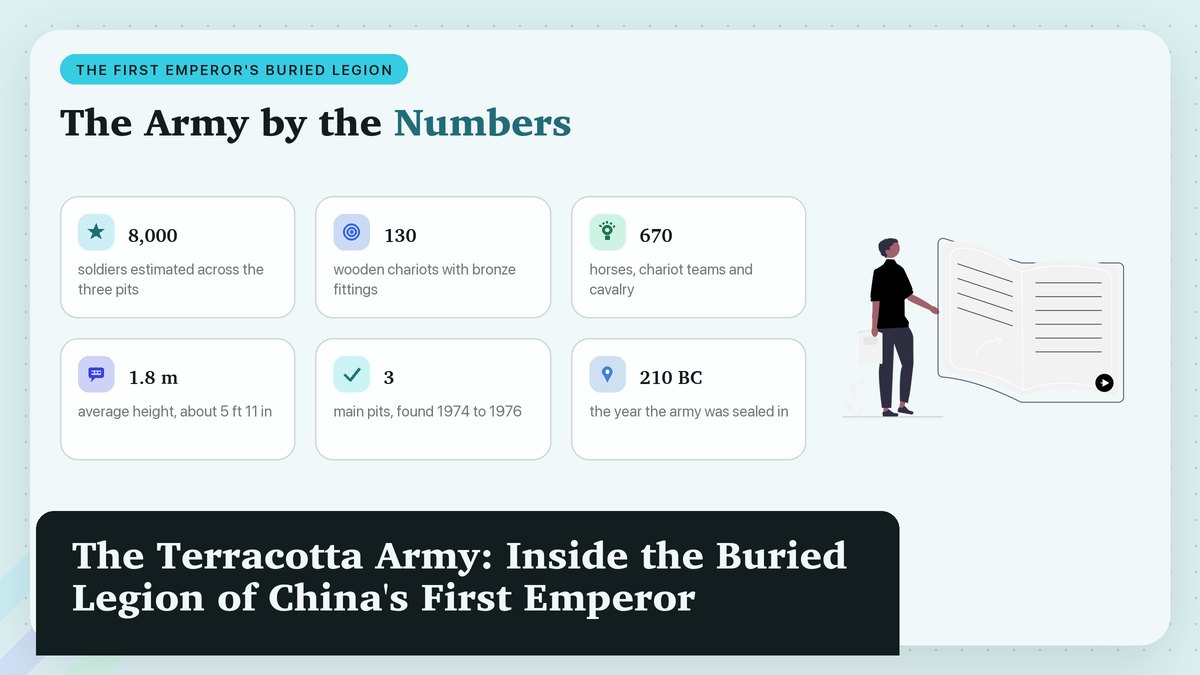
An estimated 8,000 soldiers, 130 chariots, and 670 horses stand guard in the pits, and not one of them was meant to be seen.
Three Pits, One Guard Corps
The whole formation faces east, toward the conquered states of the old Warring Kingdoms
The excavated army is organized into three main pits laid out about 1.5 kilometers (roughly a mile) east of the emperor’s burial mound, at the northern foot of Mount Li, and their contents divide by military function rather than by rank of beauty, as far as the diggers can tell. Pit 1, the one the well diggers hit, is the infantry hall. It is an oblong timber-roofed chamber about 230 meters long and 62 meters wide (755 by 203 feet), holding an estimated 6,000 figures, most of them armored foot soldiers in eleven rows behind a vanguard of archers. Pit 2 lies about 20 meters north and serves as the combined-arms wing, with cavalry units, chariot teams, kneeling and standing archers, and officers; its 1,300 or so figures are still mostly under the collapsed roof. Pit 3 is small and L-shaped, holding 68 figures arranged around a war chariot, and archaeologists read it as the army’s headquarters. Together the three pits cover more than 20,000 square meters of excavated ground.
The site today is a catastrophe scene frozen mid-recovery, and that stasis is deliberate. The wooden beam roofs, set on earthen walls, collapsed at some point in antiquity and crushed most figures into fragments, and burning shows that at least one pit was deliberately torched. Tradition hands the arson to Xiang Yu, the rebel general who sacked the Qin capital in 206 BC, a year after the dynasty fell. The attribution rests on historical texts written a century after the fire, rather than any signed confession,, but the scorched earth and the missing weapons fit the story. Soldiers were found still gripping the air where crossbows and spears had been wrenched away. In Pit 1’s exhibition hall roughly 2,000 reassembled figures now stand, each rebuilt from dozens of shards, while museum staff work at restoration benches behind glass so visitors can usually watch the gluing.

Anatomy of a Life-Sized Warrior
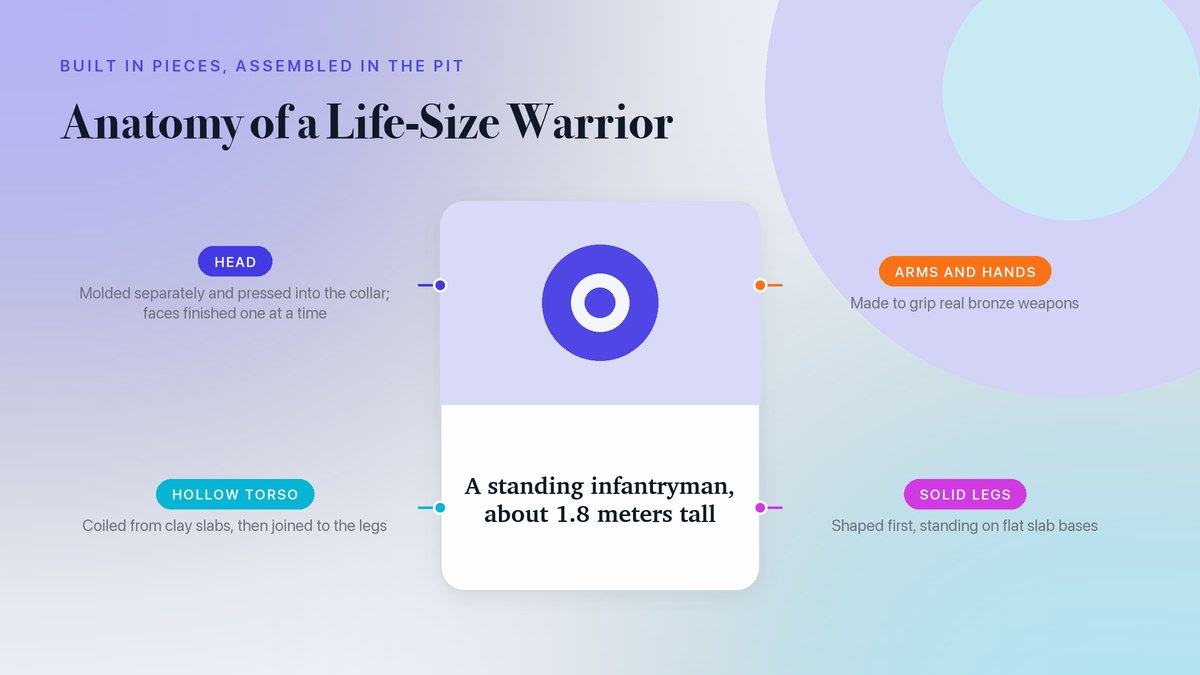
The average soldier stands about 1.8 meters (5 feet 11 inches); the tallest generals reach 1.96 meters (6 feet 5)
Walk the Pit 1 gallery and the unsettling thing isn’t the scale but the faces. The bodies were built from a modular kit of sections small enough to carry, and assembled in the pit rather than fired whole. Solid legs were shaped first and stand on flat slab bases, then a hollow torso was coiled from clay slabs, then arms, and finally a separately molded head was pressed into the collar. That assembly method is why excavators can match a broken arm to its socket meters away, and it’s also why a single collapsed rank leaves several thousand joinable pieces instead of rubble. The heads, though, were finished one at a time, with distinct cheekbones and beards, and with topknots arranged in styles that number in the dozens and seem to track rank and unit. A claim repeated in museum guidebooks since the 1980s says no two faces are alike, a line that still survives on what feels like every souvenir mug. Facial-analysis studies of the photo archive suggest the variety is real but not infinite, since artisans clearly worked from a pool of face types, sometimes pairing the same head mold with different features. The workmanship underneath the marketing holds up. Eyebrows and hair were incised strand by strand, a museum specialist can often date a figure by its hair bun, and a kneeling archer from Pit 2 stands only about 1.2 meters (4 feet) to the crown, built low and stable for the firing line.
Armor carries the same density of information. Lamellar plates laced with cord mark the front-line infantry, officers wear finer patterns, and hand positions still map to the weapons they once held. Even the flat soles are carved with tread, a detail nobody would have seen once the ranks closed. The figures were fired at temperatures near 1,000 degrees Celsius, then coated with lacquer and painted with pigments that included a synthetic purple made from barium, copper, and silica. Modern chemists reproduced that compound only in the 1980s, and the potters had it in the third century BC. The artisans also signed their work. Stamped and incised inscriptions bearing workshop names and potters’ names survive on a number of figures, the Qin equivalent of a factory stamp, which is how we know the kilns ran as official workshops with named crews.
The arsenal the soldiers carried was real metal, not ceremonial clay. Tens of thousands of bronze weapons have come out of the pits, among them crossbow triggers machined so precisely that the parts appear interchangeable, a property that startles historians of technology for the third century BC. Arrowheads were cast in matched weight batches so a volley would fly consistently. One famous claim held that Qin smiths had invented a chromium anti-corrosion coating two thousand years before chromium was isolated in the West, and the story survived in textbooks for decades. A 2019 re-analysis traced the chromium traces to contamination from nearby lacquer rather than any deliberate treatment. The bronze work doesn’t need the legend; the trigger mechanisms alone out-machine anything Europe would produce for well over a thousand years.
The Paint That Flakes Off in Minutes
Preservation chemistry, not archaeology, now sets the pace of the dig
For the first decade after 1974 the excavation ran at full speed, and a quiet disaster unfolded in the galleries. Figures that emerged with pink faces and green sleeves lost the color before visitors could see it, because two millennia of waterlogged, oxygen-starved earth had preserved a bond that air breaks. Museum conservators spent years developing the current protocol, which treats a newly exposed figure like a surgical patient: immediate humidification and thin-film wrapping, then months of gradual acclimatization in the lab. Reporting around the site’s fiftieth anniversary in 2024 described restoration teams still working through backlogs of thousands of fragments, and the pace is unlikely to quicken. Every newly uncovered figure creates a years-long obligation in the conservation lab before it can even be reassembled.
The pits have kept producing surprises all the same. A third major excavation phase inside Pit 1 ran from 2009 and turned up the first traces of surviving paint on newly exposed figures; the find pinned down the original coloring scheme. Beyond the three soldier pits, surveys have mapped an entire buried bureaucracy around the mound: chambers holding bronze waterfowl and acrobat figures, stone armor suits, a stable complex with real horses in ceramic sarcophagi, and what archaeologists take to be an unlooted accompanying tomb. The museum’s deputy director told China Daily in 2024 that more than 500 burial pits and tombs are now known across the mausoleum precinct, with over 50,000 artifacts recovered. The famous army, in other words, is only the most photogenic corner of a much larger buried court.
Chariots, Crossbows, and the Unopened Mound
The emperor’s own chamber is the one part of the complex nobody has entered
In December 1980, drillers probing a site about 20 meters west of the burial mound found a pit containing two bronze chariots, each with a team of four horses, cast at half life size. The larger is an open two-wheeled car with a kneeling driver, assembled from more than 3,000 individually cast parts by museum counts, including gold and silver fittings. Its companion is an enclosed carriage with doors and windows in a box body meant for the emperor’s spirit. It matches the ritual texts almost line for line. Both stand in the museum’s Chariot Hall, and they matter because the tomb complex wasn’t only soldiers. It reproduced the imperial transport park, the menagerie and orchestra, the kitchens; a whole court was expected to keep functioning underground.
The mound at the center of the precinct, a rammed-earth pyramid roughly 76 meters (about 250 feet) tall, stands unexcavated, and Chinese authorities have said repeatedly that it won’t be touched until non-invasive techniques can guarantee whatever is inside survives. The caution is not only bureaucratic, because the mound itself keeps proving Sima Qian right. Soil surveys published in the 2000s measured mercury levels around the mound running sharply above local background, peaking near the center, which is exactly where Sima Qian said the mercury rivers flowed, two thousand years before anyone could test for them. The old historian had a point. The automatic crossbows are harder to verify without opening the chamber, and most archaeologists assume they rotted or misfired long ago, unless the chamber stayed dry enough to preserve the mechanisms, which nobody can check without opening it. Even so, the mercury result turned one of history’s tall tales into a measured anomaly on a lab printout, and it is a large part of why the mound stays sealed.
Seeing the Army Today
The museum drew a record 11 million visitors in 2023
The site is formally the Emperor Qinshihuang’s Mausoleum Site Museum, about 40 kilometers (25 miles) northeast of central Xi’an, and it runs like a small city. A free shuttle links the pit halls, the chariot exhibition, and the mound viewpoint across the precinct. Admission has hovered around 120 yuan (roughly $17) for the main site in recent years, though the price varies with the season and with the exhibition wing. I’d advise arriving at opening time or after 15:00, because by late morning the Pit 1 gallery fills shoulder to shoulder along the front rail. Budget at least three hours if you want the chariots and the cinema as well. An English-language digital station covering 1,600 square meters opened on a trial basis in 2024, and a fiftieth-anniversary exhibition that opened in September 2024 put 230 relics on display, several categories for the first time. The anniversary also brought a Netflix documentary, Mysteries of the Terracotta Warriors, which has aired in more than 190 countries since June 2024, plus a six-part series on CCTV-10. Travelers who visited even a decade ago are seeing a different museum now.
One practical warning, documented by state media in 2017, sounds like a joke. Xi’an has a history of unofficial terracotta attractions that aren’t the army. In 2017 the city government seized and destroyed more than 40 fake warriors at one such venue after photos of unconvincing replicas circulated online, a story carried by People’s Daily. Licensed tours and taxis know the difference, but if a driver proposes a “terracotta factory” or a discount site, the real museum is the one with the long pedestrian approach and the passport-checked ticket gates, with roughly eleven million visitors a year passing through them. Independent travelers can reach the site on public bus 306 from Xi’an’s east side or by taxi in about an hour, traffic on the Lintong road permitting.
What stays with you at the end isn’t the numbers, which blur after an hour, but the restoration benches. Through the glass you can watch a technician rotate a gray shard in both hands, deciding where it belongs among a hundred labeled trays, and you soon realize that nearly every complete figure in the hall passed through that kind of judgment call. The army was raised by a regime obsessed with standardization, then smashed, burned, buried within a generation of the emperor’s death. Its recovery has so far taken twice as long as the Qin dynasty lasted. Thousands of figures are still underground, waiting for conservation science to catch up with the archaeologists’ trowels. What he got instead was a patient, centuries-long rescue organized by strangers who keep his soldiers’ faces off the floor.
Sources and further reading: this guide draws on the Terracotta Army and Qin Shi Huang reference entries, the Emperor Qinshihuang’s Mausoleum Site Museum, anniversary reporting from China Daily and Xinhua via the State Council, and the People’s Daily report on counterfeit attractions. For more on China’s imperial sites, see our guides to the Forbidden City, the Grand Canal, and China’s UNESCO World Heritage sites.