
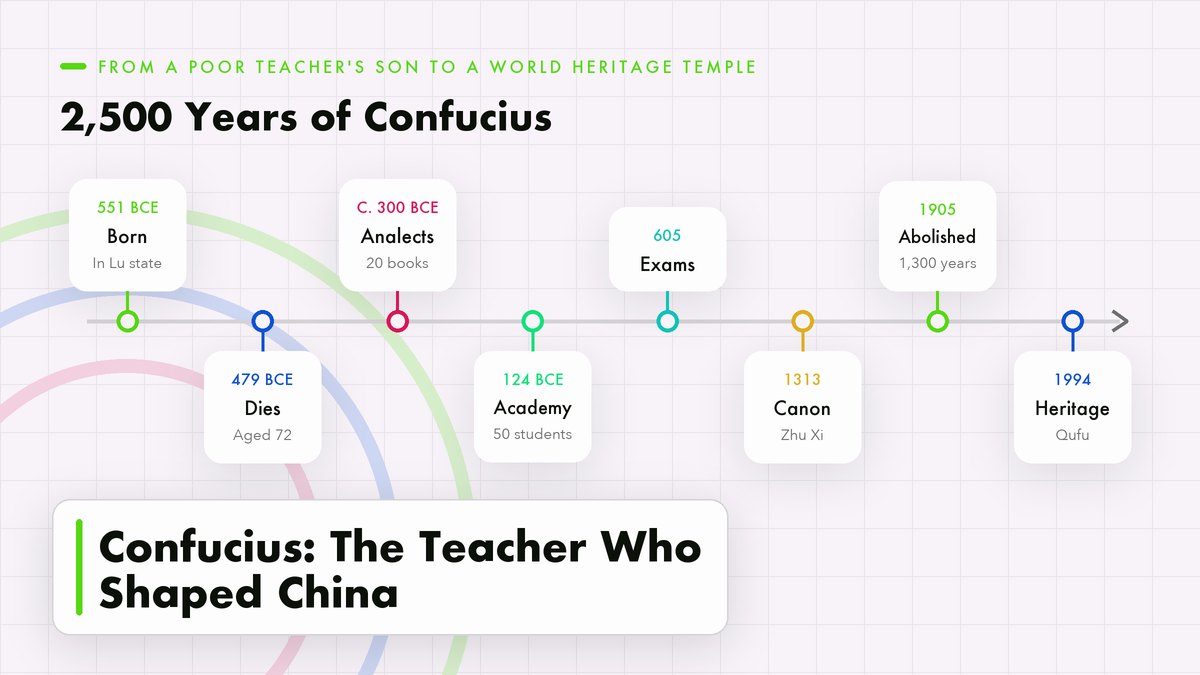
Kong Qiu never held a throne, never led an army, and left nothing he
wrote himself. Yet the sayings collected after his death in 479 BCE became the
curriculum, the civil service exam, and the state ideology of the world’s
largest empire, and they still draw visitors to his hometown temple today.
On September 28, 2026, in the courtyard of a temple in the small city
of Qufu, Shandong province, several hundred people in Ming-style robes will
kneel and bow nine times before a spirit tablet bearing the name of a man who
died twenty-five centuries ago. The service they repeat goes back to 478 BCE,
the year after the teacher’s death, when the Duke of Lu turned the dead man’s
modest house into a shrine. That shrine grew into the Temple and Cemetery of Confucius you can walk through today, a
complex the size of a small town. UNESCO inscribed it as World Heritage in
1994, together with the Kong family mansion next door. Few private citizens of
any era have been commemorated continuously for this long, and fewer still did
it without an army. What Confucius had instead was a set of sayings, roughly
five hundred of them, recorded by students who’d never have called their
master an emperor, a prophet, or a god.
In this article
A Teacher from the State of Lu, 551 BCE
The man later generations called Kong Fuzi, “Master Kong,” was born Kong Qiu
in 551 BCE in the small state of Lu, on the western edge of the North China
Plain in what is now Shandong province. His courtesy name, Zhongni, and his
dates come down to us mainly through the history Sima Qian wrote some four
centuries later; the Stanford Encyclopedia of Philosophy treats the broad outline of the
life as solid while warning that the early years are only partly solid. The
traditions do agree on one point: his family had fallen hard by the time of
his birth. The Kongs claimed descent from the Shang royal house, but his
father Shuliang He was an officer of Lu known more for physical strength than
for wealth. The boy grew up poor enough that the histories describe him
learning ritual by watching ceremonies at local temples, since nobody would
sponsor him for a formal position.
As a young man he took the bookkeeping jobs open to an educated commoner in
the Spring and Autumn period, managing granary stores and livestock accounts
for the Ji family, the most powerful ministerial clan in Lu. Those posts
matter to his later teaching, odd as that sounds, because the Analects are
full of sayings about government by example. A man who had watched one
powerful family hollow out his duke’s authority from inside the treasury had
specific reasons for distrusting officials who talked virtue and counted
grain. Around 500 BCE his career briefly brightened. Lu’s Duke Ding sent him
along on a diplomatic mission to the state of Qi, and the histories credit him
with a skillful performance at the treaty meeting at Jiagu. Soon after, he
rose to Minister of Justice in Lu, a post that put the administration of
punishments in his hands for a short while.
Fourteen Years on the Road
497 BCE: the teacher leaves Lu and spends a decade and a half looking for a ruler who will listen
The high office didn’t last. Around 497 BCE, as the traditional accounts
tell it, the neighboring state of Qi sent Lu’s rulers a gift of eighty
accomplished singing girls and a matched set of horses, and the court lost
interest in austere advice almost immediately. Confucius left Lu and spent the
next fourteen years traveling among the states of the central plain, looking
for a ruler who’d employ his ideas about good government and finding mostly
polite refusals. He passed through Wei, Song, Chen, and Cai. In one episode
preserved by Sima Qian, he and his followers were cut off between Chen and
Cai for days and ran out of food, until the disciples began to wonder aloud
whether the whole enterprise was folly.
What he taught on the road wasn’t a religion in the later sense of the word,
and it irritated people who wanted one. The Analects open not with a cosmology
but with a sentence about pleasure: “Is it not a pleasure, having learned
something, to try it out at due intervals?” The vocabulary that runs through
all twenty books of the Analects is famously compact. There is ren, usually
translated as benevolence or humaneness; li, ritual propriety in the sense of
doing things the right, considered way; xiao, the devotion children owe
parents; and the junzi, the exemplary person the student is meant to become.
When asked about government, the Master kept returning to the same ground. In
Analects 12.19 he tells a questioner that a ruler who desires the good for his
people is like wind over grass, in that the grass cannot but bend where the
wind passes. Every dynasty that quoted that line agreed with its assumption:
character transmits downward through example rather than through laws alone,
or at least it should.
“Learning without thought is labor lost; thought without learning is perilous.” — Analects 2.15
He went home in 484 BCE, an old man by the standards of the age, and spent
his last five years teaching and, by tradition, editing the old texts that
became the Five Classics. There’s the Odes, with its 305 poems, along with the
Documents, the Rites, the Changes, and the terse Spring and Autumn Annals of
his own state of Lu. When he died in 479 BCE, at seventy-two by the
traditional count, he was buried on the bank of the Zhu river north of Qufu,
on ground the Kong family still tends. His students mourned him for three
years, the story goes, and one disciple, Zigong, stayed by the grave for six.
It’s a human detail, and it matters, because everything that followed grew out
of that devotion rather than out of any command the master issued.
From Private Master to State Doctrine
The transformation of a wandering teacher into the official philosophy of an
empire took about three hundred years, and it wasn’t obvious while it
happened. Confucius’s own century was the Spring and Autumn period, when Zhou
authority had thinned into a contest among rival states. The two centuries
after his death were the Warring States, when that contest turned lethal. His
school survived because it taught something the warring states needed: a
theory of legitimate, orderly government. The Legalists who built the
bureaucracy of the Qin, the dynasty that unified China in 221 BCE, rejected
his reliance on moral example in favor of punishments and rewards. The Qin
collapsed within fifteen years, and later Confucians never tired of pointing
out the contrast.
The decisive turn came under the Han. The scholar Dong Zhongshu, who died
around 115 BCE, argued in a celebrated memorial of 134 BCE that the empire
should “dismiss the hundred schools” and honor only the teachings transmitted
through the classics associated with Confucius. Emperor Wu of Han (r. 141–87
BCE) took the advice in stages. In 124 BCE his court established the Imperial
Academy in the capital, with a faculty of Five Classics Erudites and an
entering class of fifty students, chosen so that the sons of high officials
would be trained in the same curriculum the throne now endorsed. Within two
centuries the academy was said to enroll some thirty thousand students. The
pattern set there, state sponsorship of a single classicist curriculum,
outlasted the Han itself and became the skeleton around which Chinese
government assembled for the next two thousand years. The Internet Encyclopedia of Philosophy traces this arc in detail, from local
master to cosmic moralist, and notes how little of it the historical Kong Qiu
would have recognized.
The Examination Machine: How the Sayings Became a Career
The most consequential invention in this whole story was administrative
rather than philosophical. During the Sui dynasty (581–618), with the
reunification of the empire, the court began selecting officials through
written examinations instead of aristocratic recommendation. By the Tang
dynasty (618–907) the system had settled into the shape it would keep for
centuries. The examinations tested candidates on the Confucian classics, and
success in them became the main road into government office. That meant the
sayings of a teacher from Lu turned into, quite literally, the entrance
examination for a career in the largest state on earth. If you want the
institutional side in one place, the imperial examination entry follows it from its
early Sui forms to its final abolition.
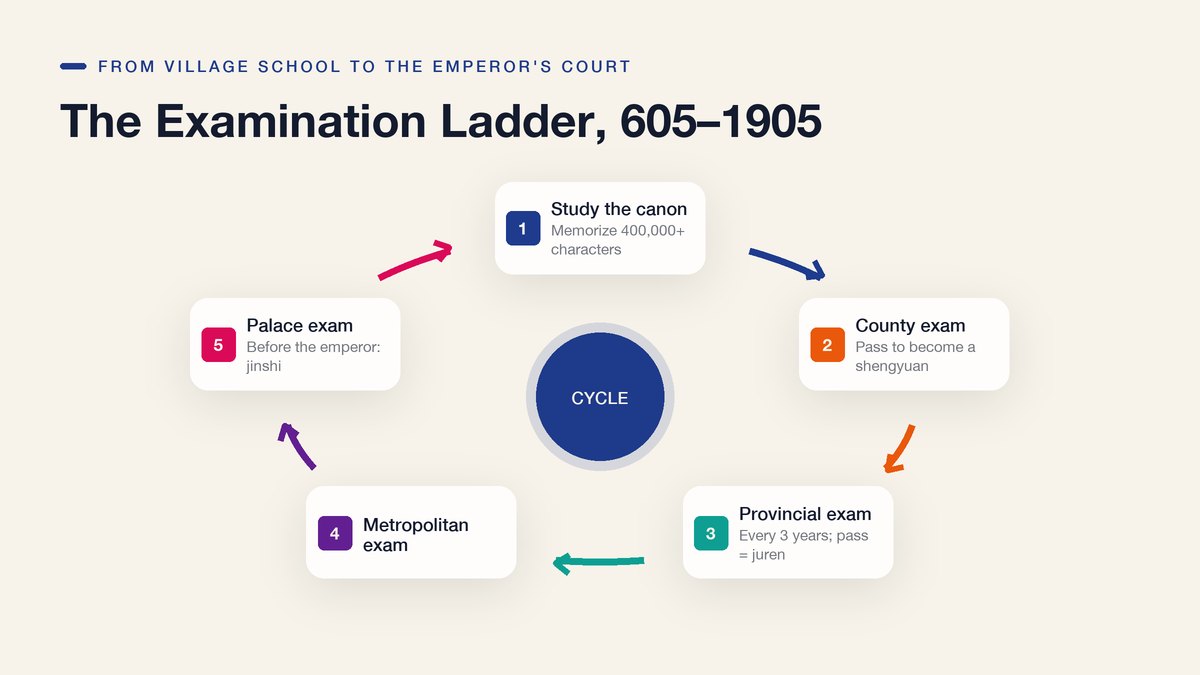
The examinations ran on a strict ladder, and each rung had its own name,
venue, and rhythm. The first examinations were held locally, often annually,
and passing them earned the status of shengyuan, sometimes called a licentiate
or “cultivated talent.” That rank exempted a man from labor service and admitted
him to the next level. The provincial examinations, given every three
years in autumn in each provincial capital, were the filter that made
reputations; a pass there made you a juren, a “recommended man,” and entitled
you to travel to the capital for the metropolitan examinations, held each
spring. The survivors of those sat a final palace examination nominally
presided over by the emperor himself. The successful candidates became jinshi,
“presented scholars,” the elite degree whose holders staffed the empire’s
senior positions.
| Stage | Where and when | What passing gave you |
|---|---|---|
| County / prefectural exam | Your home prefecture, most years | Shengyuan status: exemption from labor service, a place in the academy |
| Provincial exam | Provincial capital, once every three years in autumn | Juren degree, eligibility for the capital examinations |
| Metropolitan exam | The capital, the following spring | Admission to the palace examination |
| Palace exam | Before the emperor, days later | Jinshi, “presented scholar,” the gateway to senior office |
What candidates had to memorize staggers most people when they first see the
figures. The Four Books and the Five Classics, with their standard
commentaries, add up to well over four hundred thousand characters, and a
serious candidate was expected to reproduce passages exactly, not merely
paraphrase them. Essay answers had to follow rigid forms, most famously the
eight-legged essay (bagu wen) of the later dynasties, in which the structure
of the argument was prescribed down to the balancing of its parallel clauses.
Critics inside China attacked the system for exactly this from at least the
Song dynasty onward, arguing that it produced men who could recite the
classics and nothing else. The system’s defenders answered that, for all its
rigidity, it was the main channel by which a farmer’s clever son could rise to
govern a province. That’s more than Europe’s hereditary aristocracies
offered in the same centuries.
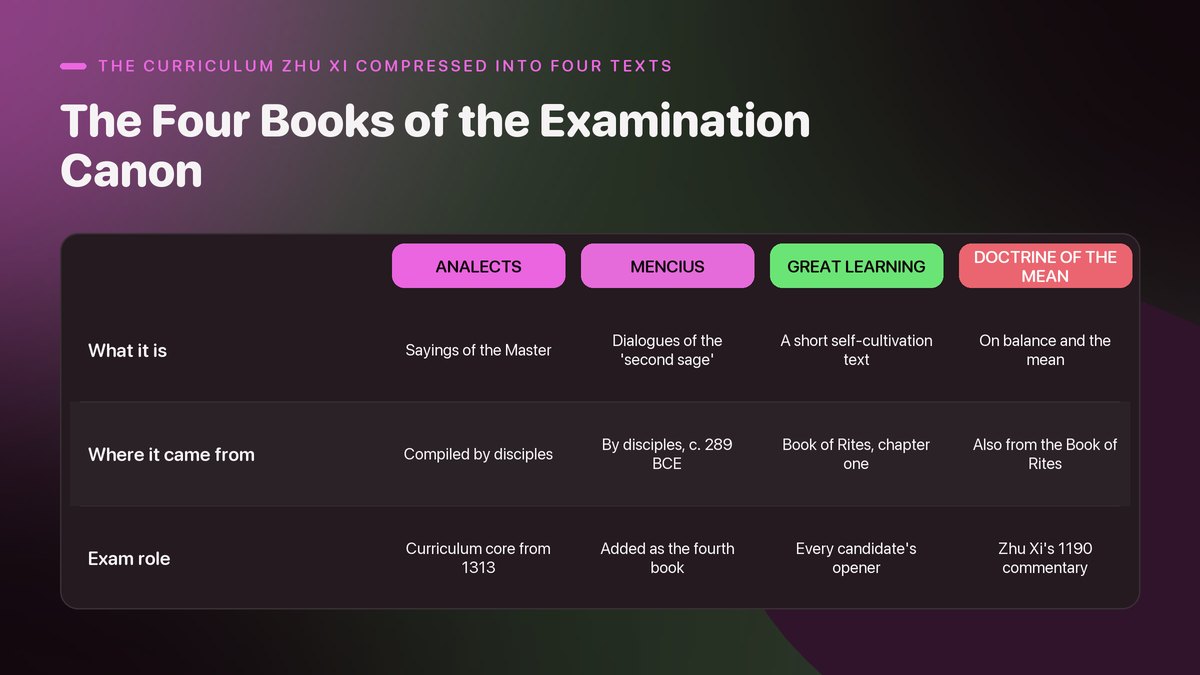
One more layer made the system nearly indestructible. In 1313, the Mongol
Yuan dynasty ordered that Zhu Xi’s commentaries on the Four Books become the
standard for all examinations. Zhu Xi, who died in 1200, had spent his life
re-reading the classics as a Song philosopher and compressing the curriculum
into exactly four texts: the Great Learning, the Doctrine of the Mean, the
Analects, and the Mencius. The last of these collects the dialogues of
Mencius, the second great Confucian teacher, who lived some two centuries
after Confucius himself; you can read about Mencius in his own right. For the
examination story, though, what matters is that one scholar’s commentary
edition of 1190 became, from 1313 until the exams ended, the single official
reading of the tradition. The examinations themselves lasted until September
2, 1905, when the beleaguered Qing government abolished them by decree,
ending a selection system that had run in recognizably this form for some
thirteen hundred years.
Qufu Today: Walking the Temple, the Mansion, and the Forest
For a traveler, the Confucius story has a specific address. Qufu is a
county-level city of about half a million people, two hours from Jinan by
high-speed rail, and it holds three adjoining complexes that together make up
the UNESCO listing: the Temple of Confucius, the Kong Family Mansion, and the
Cemetery of Confucius, known locally as the Kong Lin, the “Kong forest.” The
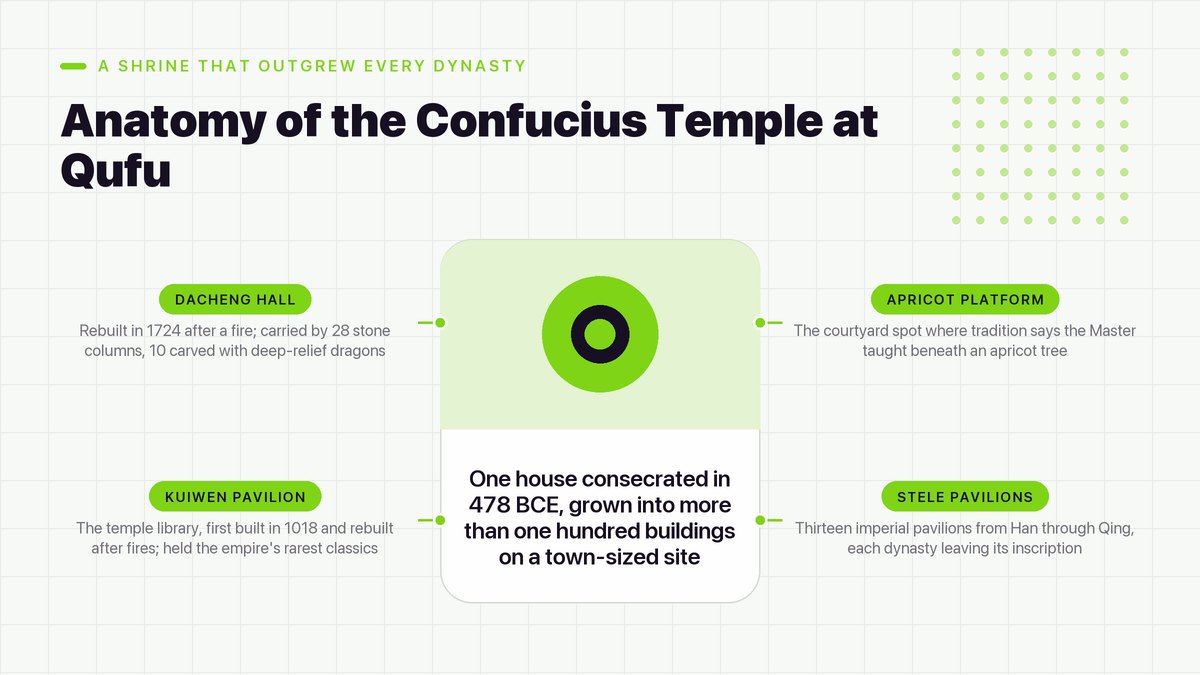
temple began as the house where Confucius had lived, consecrated in 478 BCE
by the Duke of Lu, and the mansion next door served as the residence of the
teacher’s direct descendants for most of two millennia. The modern temple is
enormous, with more than one hundred buildings across a site that grew with
every dynasty that needed to display piety toward its own official philosophy.
Its core is still a teaching space, though, and the Apricot Platform in the
central courtyard is why: that’s the spot where tradition says Confucius
taught his students beneath an apricot tree.
The building that stops most visitors is the Hall of Great Achievement, Dacheng
Dian, rebuilt in its present Qing form in 1724 after a fire. It stands on a
marble terrace and is carried by twenty-eight stone columns. The ten on the
front are carved in high relief with coiling dragons so deep that the scales
look undercut, a carving job that took, local tradition says, years of work.
Behind the hall, the Kuiwen Pavilion holds what was once the temple’s library,
first built in 1018 during the Song dynasty and rebuilt after fires. Its
double-eaved roof shelters shelves that once held the empire’s most precious
classical editions. A row of thirteen imperial stele pavilions straddles the
courtyard, erected by emperors from the Han through the Qing to leave their
own inscriptions on the temple grounds. That row tells you something
important: every dynasty, including foreign-founded ones like the Yuan and the
Qing, found it worthwhile to leave its mark beside the Master. The city of Qufu around the temple still follows its old plan loosely,
with the temple and mansion sitting at the center and the drum tower anchoring
the old commercial street to the north.
The Kong Family Mansion tells the family’s side of the story. From 1055,
when the Song court granted the title Duke Yansheng, “Duke for Perpetuating
Sageliness,” to the forty-sixth-generation descendant Kong Zongyuan, the
eldest Kong line held a hereditary dukedom in the county for nearly nine
hundred years. The mansion they enlarged across the Ming and Qing contains
some 463 rooms arranged in nine courtyards. The title itself outlived the
empire: the Republic of China converted the last holder, Kong Decheng, into an
honorary official in 1935. When he died in Taipei in 2008, the line that had
begun with a poor teacher’s son in 551 BCE was some seventy-eight or
seventy-nine generations deep, depending on how you count the early ones. The
cemetery north of town, where the master himself lies beneath a modest earthen
mound, holds the graves of over one hundred thousand Kong descendants and is
often described as the largest family cemetery in the world.
long day but exhausting as a single push; the temple and mansion sit wall to
wall in the old town, while the Kong Lin cemetery lies about 1.5 km north, an
easy taxi or a pleasant bike ride past the moat. Come in late April if you can,
when the temple’s ancient cypresses are green and the courtyard apricot is in
bloom, or time a visit for the September 28 memorial ceremony, which fills the
Dacheng Hall courtyard with robed participants in Ming-style dress.
Reading the Analects Today
If you want to see why any of this worked, read the book itself. It’s
shorter than most people expect: about five hundred passages, most of them two
or three sentences long, grouped into twenty books named after their opening
words. The whole thing can be read in an evening, and the Analects are the kind
of text where a two-sentence saying can carry an entire argument. Two examples from the twenty books
are worth holding onto. Analects 2.4 has the Master describing his own moral
development by decade, “at fifteen I set my heart upon learning,” and ending
with “at seventy I followed my heart’s desire without overstepping the line,”
a sentence people still quote when they turn seventy. Analects 15.24 gives the
negative form of the golden rule: “Do not do to others what you do not want
done to yourself,” a formulation that needs no theology to endorse.
The text survived so well partly because of how it was edited and partly
because of what kind of book it is. As a book, the Analects rarely argue; they
show the Master answering particular students, and the answers shift with the
student asking. The result is a habit of attention to persons rather than a
system. As an edited tradition, the canon kept absorbing rival materials: the
Mencius added an argument that human nature tends toward the good, the Great
Learning compressed the whole program into a few hundred characters about
investigating things and extending knowledge, and Zhu Xi’s twelfth-century
commentaries tied the four texts into one ladder of study. Later readers in
Korea studied the same sentences for five centuries, because the Joseon
dynasty made the same curriculum its state ideology, and so did the samurai
bureaucrats schooled in Tokugawa Japan’s Confucian academies. When the Jesuit
missionary Matteo Ricci latinized Kong Fuzi as “Confucius” around the year
1600, he handed Europe a name for a philosophy it would argue about for the next
two hundred years. Voltaire kept a portrait of the Master and quoted him
against the Church, a strange afterlife for a man who died
complaining that no ruler would employ him.
What the Master Still Asks
The last emperor abdicated in 1912 and the examinations ended in 1905, yet
the September 28 ceremony at Qufu still happens every year. It was revived in
1984, after the decades in which Confucius was officially an enemy of the
state, most luridly during the 1973–74 “Criticize Confucius” campaign of the
late Cultural Revolution. Since 2004 the language institutes China sponsors
abroad have carried the Master’s name, the first Confucius Institute having opened in
Seoul that November. Neither fact settles anything by itself. A name that has
served dukes, emperors, revolutionaries, and ministries of education is a name
being used, and the user always matters. What a visitor to Qufu actually
encounters is more modest and more durable than any of that: a courtyard, an
old apricot tree, and the short sayings of a man who believed that if you
cannot govern yourself, you have no business governing anyone else. The empire
that built its exams on that sentence is gone, and the sentence remains,
carved in stone at the temple and quoted from Seoul to Vancouver. You can
stand where he taught about an hour from the high-speed rail station, and you
don’t need to pass an examination to get in.
Sources and further reading: the Stanford Encyclopedia of Philosophy
and the Internet Encyclopedia of Philosophy entries on Confucius; the full Chinese text
of the Analects at the Chinese Text Project. Dates and figures follow the scholarly
consensus as of this writing; traditional accounts cited in the text are
flagged as such.
Keep reading
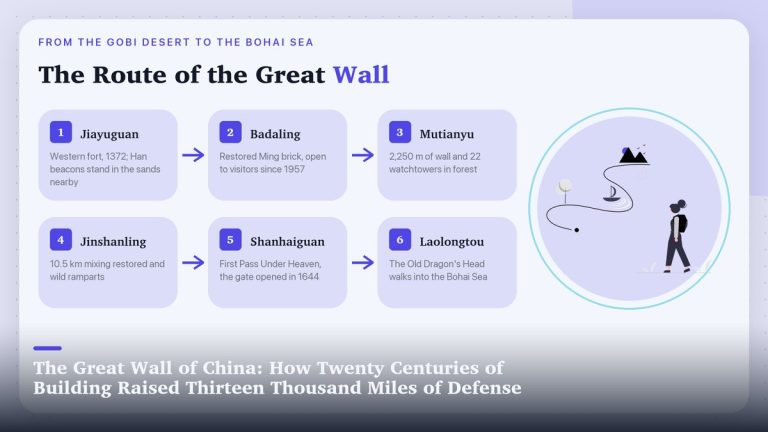 History & HeritageThe Great Wall of China: How Twenty Centuries of Building Raised Thirteen Thousand Miles of Defense
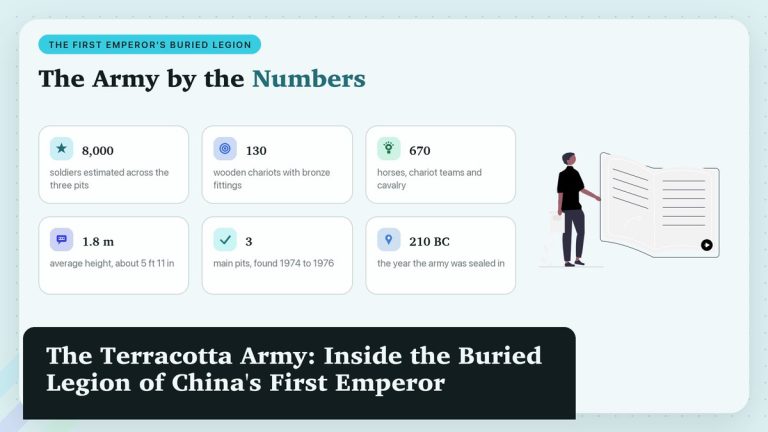 History & HeritageThe Terracotta Army: Inside the Buried Legion of China’s First Emperor
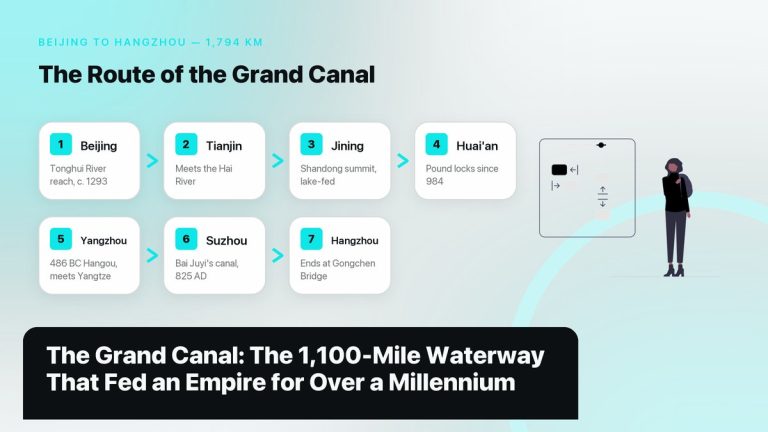 History & HeritageThe Grand Canal: The 1,100-Mile Waterway That Fed an Empire for Over a Millennium